Contact us

2026 Best Automatic Water Spray Retort Steam Sterilizer?

Choosing the best Automatic Water Spray Retort Steam sterilizer in 2026 depends on the product, package, and production target. A machine that suits one food or container may not suit another. The right choice is not simply the model with the largest capacity or the most automation.

A careful comparison should examine temperature control, water circulation, loading arrangements, cycle records, and operator access. Ask how the retort handles your actual package size and product recipe. Request documented test results, installation requirements, and service details from the manufacturer. These details matter. A clear interface can help operators follow a process, but it cannot replace validated procedures or trained staff.

Also consider energy and water use under realistic operating conditions. Ask suppliers how they measure those figures; advertised values may rely on different assumptions. Confirm that the proposed system can be integrated with your existing line and maintenance practices. Small design choices, such as basket handling and access for cleaning, can affect daily work more than a polished brochure suggests.

This guide outlines practical questions for comparing available systems and assessing supplier claims. It does not assume that one retort is best for every facility. Some criteria are difficult to compare without a product trial or qualified technical review. That uncertainty deserves attention. A confident purchase decision comes from matching verified performance to your process, not from relying on a headline or a single specification.
2026 Best Automatic Water Spray Retort Steam Sterilizer?

What Is an Automatic Water Spray Retort Steam Sterilizer?

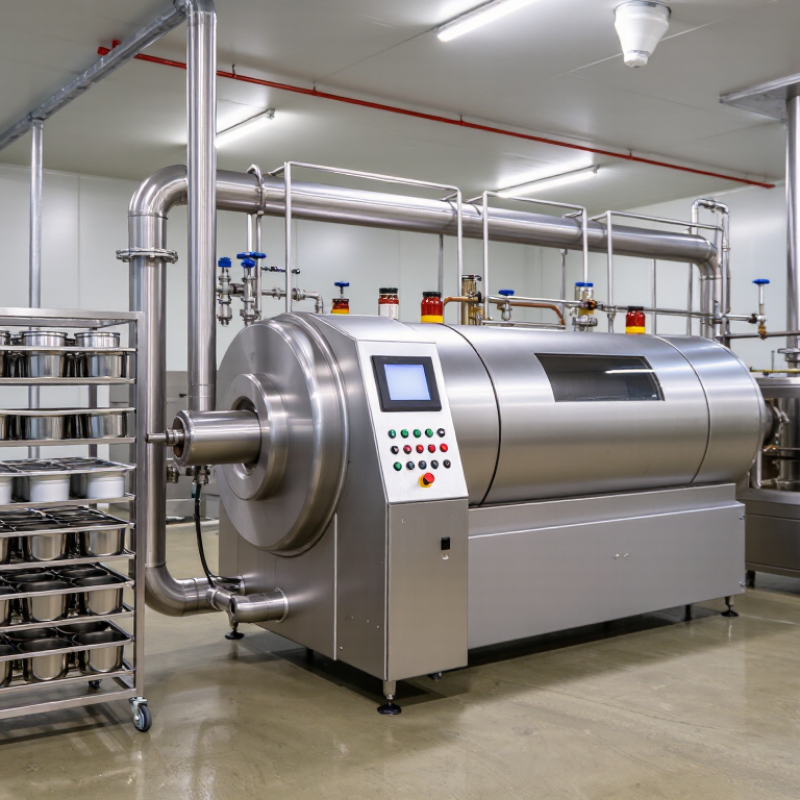
An automatic water spray retort steam sterilizer is a closed vessel that heats sealed food containers using recirculated hot water and steam. Pumps spread water across trays or baskets, while controls track temperature, pressure, and cycle time. The aim is even heat treatment, including at the slowest-heating point inside a container. Not just a hot chamber. The water spray helps reduce temperature differences, though loading patterns and package size still affect heat transfer. Cooling follows the heating stage, often with pressure control to protect containers from distortion.

The process must be validated for the specific food, container, and load. A temperature such as 121.1°C may appear in thermal-processing references, but it is not a universal recipe; the required time depends on the product and its heat penetration. FDA regulations in 21 CFR Part 113 require scheduled processes for low-acid canned foods. The CDC estimates that 48 million people in the United States experience foodborne illness each year, underscoring why process control matters. That figure is broad, not a measure of retort-related illness. One detail operators can underestimate is sensor placement: a precise display cannot prove that the coldest container received enough heat. I’d also question any cycle chosen only because it worked for a different package.

2026 Best Automatic Water Spray Retort Steam Sterilizer? - What Is an Automatic Water Spray Retort Steam Sterilizer?
Dimension Typical information Practical note
What it is A sealed pressure vessel that heats packaged products using recirculated hot water distributed through spray nozzles. It combines water-spray heat transfer with controlled pressure and temperature during processing and cooling.
Typical applications Thermally processed foods in cans, glass jars, retort pouches, and other heat-resistant sealed containers. The container must be suitable for the specified temperature and pressure conditions. Product formulation and package geometry affect the process.
Common process temperature Many commercial retort processes operate in the approximate range of 110–121 °C; actual schedules may differ. The required temperature and holding time must be established for the specific product, container, and equipment.
Pressure control The vessel uses controlled pressure during heating and cooling; the operating setpoint depends on the process and package. Overpressure can help protect flexible or semi-rigid packages from swelling, distortion, or seal damage. It is not a universal fixed value.
Typical cycle stages Loading, venting or air removal as required, heating, come-up, holding, cooling, and unloading. The programmed sequence and transition conditions should follow the validated process schedule.
Water circulation A pump circulates heated water through a distribution system and spray nozzles over the product load. Consistent water distribution and appropriate loading patterns help support uniform heat transfer.
Heating and cooling Heating may use steam or another configured heat source; cooling commonly uses water while pressure is controlled. Cooling-water quality, cooling rate, and pressure control should be appropriate for the package and plant requirements.
Automatic controls A control system can manage programmed temperatures, pressure, circulation, timing, alarms, and cycle records. Automation supports repeatability but does not replace calibration, operator oversight, or process validation.
Process verification Commercial thermal processes are set using product-specific heat-penetration and process data. A qualified process authority should establish or review the scheduled process, especially for low-acid foods.
Selection considerations Assess vessel capacity, package format, loading method, heating utility, cooling-water needs, controls, and applicable pressure-vessel requirements. Compare equipment against the intended product mix and validated process requirements rather than relying on a single headline specification.

Note: Operating ranges are general references only. Actual equipment limits and sterilization schedules vary by design, product, package, and process validation.

How the Water Spray Sterilization Cycle Works

2026 Best Automatic Water Spray Retort Steam Sterilizer?

How the Water Spray Sterilization Cycle Works

A water spray cycle starts with sealed products loaded into the retort basket. The vessel closes, and heated water circulates through spray nozzles across the packages. In many systems, steam or a heat exchanger raises the water temperature. Sensors track product-zone temperature and vessel pressure. The programmed holding period begins only after the target conditions are reached. Pressure helps protect containers from deformation, but the correct setting depends on the package and process.

After the holding period, controlled cooling lowers product temperature while pressure remains managed. The exact sequence varies by retort design and product. A cycle that works for one package may not suit another. Confirm time and temperature schedules through qualified process review, and keep reliable records. Real equipment can behave imperfectly; a small loading change may affect heat distribution, so verify rather than assume.

Key Components and Control Systems

2026 Best Automatic Water Spray Retort Steam Sterilizer? Key Components and Control Systems

An automatic water spray retort relies on coordinated mechanical and control components. Its pressure vessel holds product baskets and withstands operating pressure. A recirculation pump moves heated water through spray headers, while a heat exchanger helps regulate temperature. Spray nozzles distribute water across the load. Blocked or uneven nozzles can create cold spots, so inspection matters. The control system typically includes a PLC, operator panel, temperature and pressure sensors, and a process recorder. Together, these components monitor and document each cycle. Sensors need routine calibration. Small errors matter.

Tips: Check nozzle coverage and pump condition during scheduled maintenance. Review recorded data for unusual temperature or pressure patterns. Confirm that alarms and interlocks respond as intended.

Good control logic manages heating, holding, and cooling stages, while interlocks prevent operation outside defined limits. Operators should be able to see key readings clearly, including chamber temperature and pressure. A readable display helps during busy production shifts. Still, automation is not a substitute for a validated process or trained staff.

Product arrangement, container size, and load density can affect heat distribution. The exact effects vary. That part is easy to underestimate. Keep maintenance records, investigate recurring deviations, and follow qualified process guidance when changing loads or settings. A clear control system supports consistent operation, but it cannot correct every setup problem.

Food Products and Packaging Suitable for Retort Processing

Retort processing suits foods that need stable storage after sealing, including soups, sauces, vegetables, beans, seafood, meat, and complete ready meals. An automatic water-spray retort heats packages with circulating hot water while controlling temperature and pressure. The exact process depends on the food, package size, and heat-transfer behavior. Thick chili with whole beans warms differently from a thin broth. Small details matter.

Suitable packaging may include metal cans, glass jars, retort pouches, and heat-resistant trays or cups. Each format must be designed for retort temperatures and pressure changes. Flexible pouches can save space, but seals and laminate layers need careful evaluation. Glass jars require attention to thermal shock and headspace. A package that looks sturdy may still fail at its seal.

Product formulation also matters. Large pieces, dense fillings, and uneven fill weights can create slower-heating areas inside a pack. Process validation should consider the cold spot, package orientation, and loading pattern, rather than relying on surface temperature alone. Check seal integrity and package condition after trials. This step is easy to underestimate. The suitable choice is the one that protects both food quality and process safety under verified operating conditions.

How to Evaluate and Select a Retort Sterilizer in 2026

2026 Best Automatic Water Spray Retort Steam Sterilizer? How to Evaluate and Select a Retort Sterilizer in 2026

Choose a retort by matching its process to your product and package, not by comparing advertised capacity alone. Water-spray systems circulate heated water over containers, so ask how spray coverage changes with basket loading. Check whether the supplier can document temperature distribution and heat penetration for your actual package sizes. A small pouch and a deep tray may heat very differently. Request clear records of cycle temperature, pressure, timing, and any alarms. Data matters.

Tips: Bring sample containers and a realistic load pattern to a factory test. Confirm that operators can review recipes, manage access, and retrieve batch records without relying on handwritten notes. Ask how the system handles sensor faults and power interruptions. These details are easy to overlook.

Also examine vessel construction, door interlocks, controls, and maintenance access. Ask for a service schedule and the expected availability of common replacement parts. Most importantly, have a qualified process authority establish and validate the thermal process for each product and package. A machine’s preset recipe is not proof of suitability. Compare repeatability across test runs, not just one successful cycle. I would still leave time for operator feedback; a polished control screen can hide awkward daily tasks.

2026 Guide: Evaluating an Automatic Water-Spray Retort Sterilizer

Suggested buyer-defined evaluation weights (%) for comparing retort systems. These are an illustrative framework, not market-survey results.

Prioritize validated thermal-process performance and suitability for your product, container, and load pattern. Confirm temperature distribution, process records, capacity, utility requirements, and service support with the supplier; validate the scheduled process with a qualified process authority.