Contact us

What Is the Best Industrial 3D Printer to Buy?

Choosing the best industrial 3D printer is not a matter of buying the largest machine or the newest technology. The right choice depends on what you make, how many parts you need, and what performance those parts require. A metal aerospace component, a polymer fixture, and a short-run production tool demand very different equipment. Even within one process, build volume, material compatibility, accuracy, and production speed can change the decision.

The market is expanding, but growth alone does not identify the right machine. ASTM International’s Wohlers Report 2024 estimated that the global additive manufacturing industry generated $20.035 billion in revenue in 2023, an 11.1% increase over 2022. That figure covers more than printers, including materials and services. It signals a broadening industry, not a guarantee that every factory will benefit from buying a system. That distinction matters.

A practical comparison should look beyond the purchase price. Consider the full cost of ownership: installation, operator training, maintenance, material handling, software, and post-processing. Ask vendors for sample parts made with your materials, plus realistic estimates for cycle time and repeatability. Check how quickly the machine can be serviced. A printer that sits idle is expensive.

There is no universal winner. The best industrial 3d printer is the one that fits your production requirements and can deliver dependable results on your shop floor. This guide compares the factors that matter, including technologies, applications, and ownership costs. Some trade-offs are easy to miss. That is worth questioning.
What Is the Best Industrial 3D Printer to Buy?

What Defines an Industrial 3D Printer

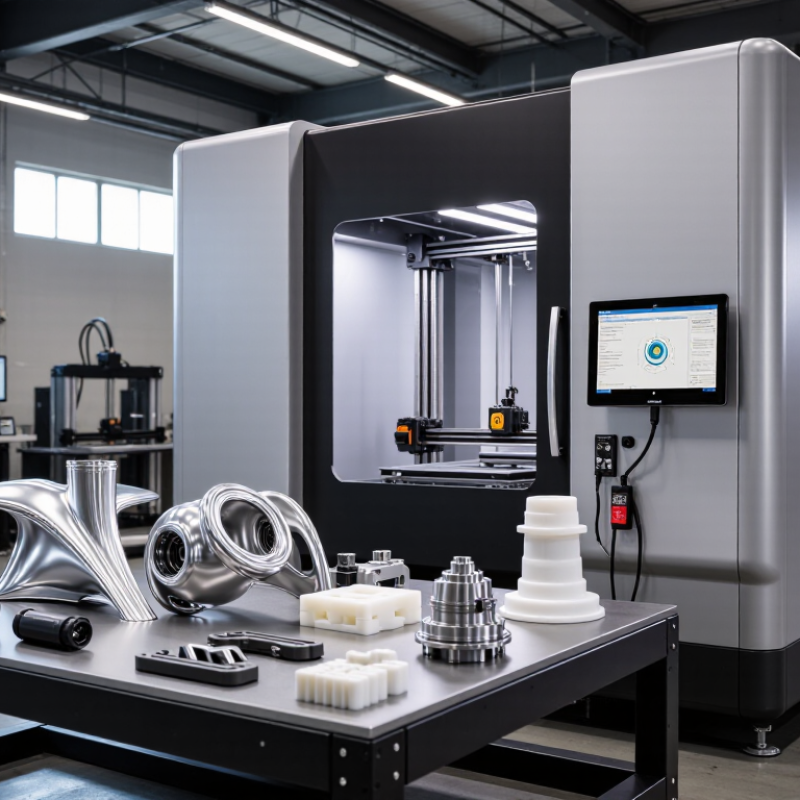
An industrial 3D printer is not defined by a metal enclosure or a high price alone. It is designed to produce repeatable parts through controlled, dependable processes. It should maintain stable temperatures, handle materials consistently, and complete long jobs with minimal interruption. Operators also need clear maintenance procedures, available spare parts, and practical training. A polished machine is not enough.

For a buying decision, look beyond headline speed and build volume. Check whether the printer can hold the tolerances your parts actually require. Review sample builds for warping, rough edges, and variation between repeated parts. Ask how calibration, software updates, and service support work in daily use. The specification sheet can mislead; a large build area is of little value if few parts fit it efficiently. A sensible test is to print a representative part several times, then compare measurements and surface quality. Even this test has limits. Different materials and room conditions can change results.

Tips: Ask for a sample build using your intended material and geometry. Confirm service response times, routine maintenance needs, and the cost of consumables. Think about operator workload, too. It is easy to overlook.
How to Identify Your Production Requirements

Choosing an industrial 3D printer starts with the parts you must deliver, not the machine’s headline speed. List the required material, maximum part dimensions, target quantity, and acceptable tolerances. Include the awkward part with thin walls or a long overhang; it may dictate the process more than your simplest sample.

Wohlers Report 2024 estimated that the global additive manufacturing industry generated $20.035 billion in 2023, an 11.1% increase over 2022. This figure covers the broader industry, not printer sales alone. Growth is useful context, not a purchasing reason.

Translate demand into a realistic weekly schedule. For example, record whether you need 30 housings or 300 brackets, and when each batch must be ready. A build may take hours, but cooling, support removal, finishing, and inspection also consume time. Measure it. Ask operators to estimate hands-on labor per batch, not just machine runtime.

Then check the build envelope against real parts, including space for supports and orientation. A stated tolerance is meaningful only when your inspection method can verify it.

Check facility needs before requesting quotations: ventilation, power, compressed air, floor space, and operator training can change the true cost. Request sample parts made from your intended material, then inspect critical features and repeatability across builds.

One uncomfortable gap in many plans is uncertain demand. If orders vary, a printer sized for peak volume may sit idle; a small pilot can expose that risk, though it will not predict every production problem.

How Printing Technologies and Materials Affect Printer Choice

Choosing an industrial 3D printer starts with the part, not the machine. Powder-bed fusion can produce intricate nylon ducts without separate support structures, while fused-filament systems may suit larger fixtures made from engineering thermoplastics. Vat photopolymerization captures fine surface detail, but its resin parts may need careful post-curing and can be less suitable for heat or impact. That matters.

Material requirements narrow the choice quickly. A metal powder-bed system needs controlled powder handling and validated parameters; a polymer printer may be easier to operate, but its build direction can affect strength. Check temperature, chemical exposure, dimensional tolerances, and the finish a part actually needs. Then print a representative sample. A glossy demo part proves little. It is easy to overvalue advertised build volume and underestimate the cost of finishing, rejected parts, and operator time.

Wohlers Associates’ Wohlers Report 2024 estimated that the global additive manufacturing industry reached $21.9 billion in 2023, up 11.1 percent from 2022. That growth signals expanding use, not one universally superior process. For a defensible purchase, compare machines using the same material, geometry, and acceptance criteria. Ask for repeatability data, not just a single successful print. I would still question any recommendation that ignores maintenance and material availability; those details are less exciting, but they can decide whether a printer earns its floor space.

What Is the Best Industrial 3D Printer to Buy?

How printing technologies and materials affect printer choice

Typical layer-thickness ranges vary by machine, material, and settings. Finer layers can improve detail but may increase build time. Choose a technology based on the materials and part properties you need, as well as productivity and total cost.

How to Compare Build Capacity, Accuracy, and Throughput

Choosing an industrial 3D printer means comparing usable capacity, verified accuracy, and finished-part throughput—not headline specifications. Wohlers Report 2024 estimated that the additive manufacturing industry grew 11.1% in 2023, reaching about $20 billion. That growth signals wider adoption, but it does not prove any machine will suit your production line. Measure your largest real part, including supports and orientation, then leave room for nesting and repeat jobs. A large build volume can still waste space.

Accuracy needs a shop-floor test. Use a representative part with holes, thin walls, and a flat reference face. Measure it after printing and post-processing, across repeated builds. ISO/ASTM 52902 provides a framework for assessing geometric capability; ask suppliers for comparable test results, not just a single tolerance figure. Small parts? Measure twice.

Throughput should mean acceptable parts delivered per shift, including setup, cooling, removal, and finishing. Ask for cycle-time data using your material and job layout. Then run a pilot. A spec sheet can mislead, and I would not treat a fast print mode as proof of reliable output. Track scrap and operator time too. Those numbers are easy to overlook.

How to Evaluate Total Cost, Service, and Long-Term Reliability

The best industrial 3D printer is not always the one with the lowest purchase price. Compare total cost over several years: installation, materials, software, maintenance, training, and expected downtime. The Wohlers Report 2024 valued the global additive manufacturing industry at about $20.0 billion in 2023, up 11.1% from 2022. That growth shows a maturing market, but it does not guarantee that a particular machine will pay for itself. Build a cost-per-usable-part estimate using your own production volumes and reject rates.

Service can matter more than a small difference in print speed. Ask for documented response times, local technician coverage, spare-parts availability, and references from users running similar materials. Request a sample build, then inspect dimensional consistency and surface finish. A printer that sits idle while awaiting a specialist can quickly erase projected savings. I would still treat vendor uptime figures cautiously; definitions and test conditions may differ.

Tips: Ask for a written five-year cost model, including consumables and service. Check what happens when a critical component fails, and confirm training for every shift. Keep assumptions visible. A neat spreadsheet can still be wrong.

What Is the Best Industrial 3D Printer to Buy? - How to Evaluate Total Cost, Service, and Long-Term Reliability

Illustrative planning comparison for industrial systems. Costs are broad USD estimates and vary with configuration, region, workload, and supplier terms.
Industrial Printer Type Typical Equipment Price Estimated Annual Service Estimated Annual Materials and Consumables Five-Year Budget Range Service and Reliability Checks Good Fit When
Industrial polymer FFF $50,000–$250,000 $5,000–$25,000 $5,000–$30,000 $125,000–$725,000 Confirm calibration frequency, replacement-part lead times, support coverage, and performance with the intended engineering materials. Check whether drying and controlled material storage are included. Durable fixtures, tooling, prototypes, and larger parts where material choice and relatively straightforward operation matter.
Industrial SLA $100,000–$500,000 $10,000–$50,000 $15,000–$80,000 $275,000–$1,450,000 Review resin handling and disposal requirements, optical-system maintenance, tank and build-platform replacement costs, and the availability of application support. Detailed prototypes and end-use parts requiring fine features and smooth surface finish, with budget and procedures for resin post-processing.
Polymer powder bed fusion (SLS) $150,000–$600,000 $15,000–$60,000 $20,000–$100,000 $400,000–$1,900,000 Check powder handling and refresh guidance, filter and thermal-system maintenance, cleaning equipment needs, and service access to the build chamber. Nested batches of functional polymer parts where design freedom and production of multiple parts per build are valuable.
Metal powder bed fusion (PBF) $500,000–$1,500,000+ $50,000–$150,000 $30,000–$200,000 $1,150,000–$4,500,000+ Assess installation and facility requirements, powder safety controls, inert-gas supply, preventive maintenance, operator training, and access to qualified repair and process support. Metal components with complex geometries or consolidation opportunities, when the organization can support substantial process, facility, and post-processing demands.

How to interpret the five-year budget: The ranges are illustrative totals for equipment plus five years of estimated service, materials, and ordinary facility or post-processing operating allowances. They exclude labor, taxes, financing, major facility construction, and the cost of production downtime. Before purchasing, request a written quote based on your expected build hours, materials, service coverage, spare parts, installation, training, and required post-processing. Compare guaranteed service response and repair terms rather than relying on a general uptime claim.