Contact us

What Is the Best Office Water Dispenser in China?

What Is the Best Office Water Dispenser in China? The answer depends on water quality, staff numbers, maintenance discipline, and daily usage. A compact dispenser may suit a five-person studio, while a busy factory office needs faster heating, cooling, and refill capacity. The best choice is practical, not impressive.

Industry reports show why this question matters. Grand View Research identifies continued growth in China’s bottled water and point-of-use water treatment sectors, driven by urban workplaces and stronger hygiene awareness. The World Health Organization’s Guidelines for Drinking-water Quality also place risk management above appearance or brand reputation. In China, GB 5749-2022 defines updated requirements for drinking-water quality, giving buyers a useful compliance reference. These sources suggest that filtration performance, microbial control, and maintenance records deserve close attention.

An Office Water Dispenser should provide stable temperature control, clear filter-life reminders, and accessible internal parts. Look for tested claims, preferably supported by recognized standards such as NSF/ANSI requirements where applicable. Ask how often filters must be replaced. Ask who performs servicing. A stainless-steel hot-water outlet, child-safety lock, and drip-free tray can matter more than a glossy touchscreen.

There is no perfect model.

In real offices, filters are sometimes replaced late, and usage estimates are often optimistic. That weakness should be admitted. A reliable purchasing decision compares tested water output, energy consumption, warranty terms, and local service coverage. For most Chinese offices, the best dispenser is the one that delivers safe-tasting water every day and remains maintainable after the sales team leaves.
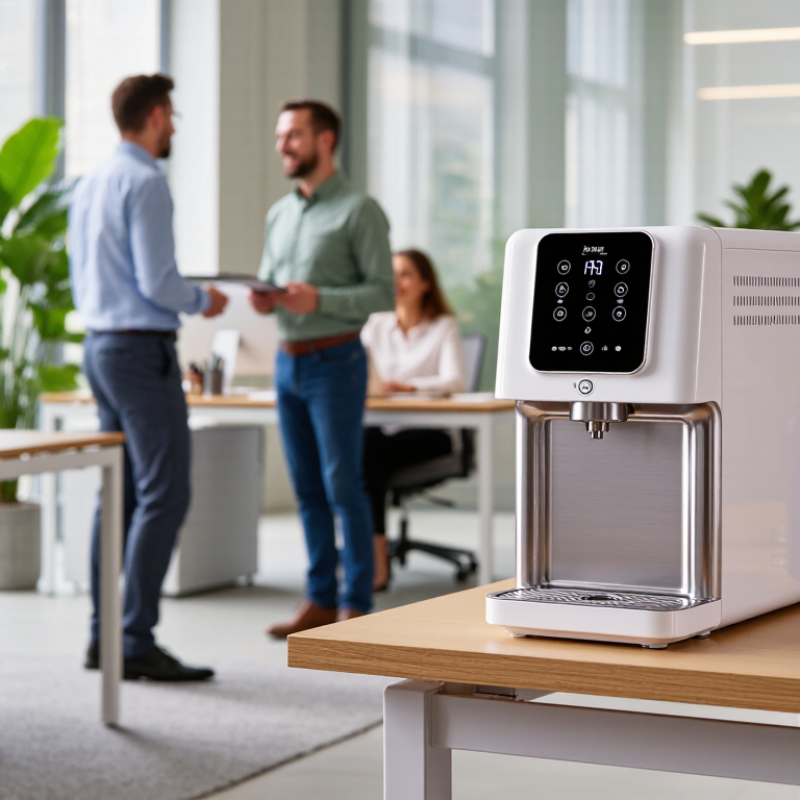
What Is the Best Office Water Dispenser in China?

Types of Office Water Dispensers Available in China

China’s office water dispenser market offers several practical formats. The main choice is between bottled and point-of-use systems. Bottled dispensers use replaceable containers and suit small offices with limited plumbing. They are simple, but storage space and manual lifting can become daily problems. Point-of-use dispensers connect directly to the mains supply. According to China Water Resources Bulletin 2023, urban public water-supply coverage reached about 99.4%, supporting wider use of direct-piped equipment.

Filtration creates another important difference. Ultrafiltration systems retain many particles and microorganisms while preserving more minerals. Reverse osmosis systems provide finer purification and suit offices concerned about dissolved solids. However, they usually produce wastewater and need timely filter replacement. A 2023 report from the China Household Electrical Appliances Association noted continued growth in household water-purification demand, reflecting stronger attention to filtration quality. Office buyers should inspect incoming water, not just compare filtration labels.

Heating design also separates models. Traditional hot-and-cold units keep water in storage tanks. Instant-heating units reduce standing water and can offer faster temperature control. Countertop models save floor space. Floor-standing models work better for shared kitchens and larger teams. Energy use matters. The International Energy Agency reports that standby consumption remains a meaningful efficiency issue across appliances. Small details matter. In practice, maintenance records are often weaker than expected. A dispenser can have excellent specifications, yet poor cleaning routines can undermine the result.

Key Features to Compare for Office Use

What Is the Best Office Water Dispenser in China?

Key Features to Compare for Office Use

In a busy office, convenience matters more than showroom appearance. Compare daily capacity, dispensing speed, and recovery time during peak breaks. A small tank may serve a quiet team, but it struggles after several users. For larger offices, separate hot and cold controls reduce waiting. Noise matters too. Place the unit near desks, and compressor noise becomes surprisingly distracting. Look for adjustable temperatures, child safety locks, leak protection, and a stable drip tray. For offices in China, confirm 220V compatibility and check relevant safety certification.

Filtration deserves careful checking. Use independently verified test data when available, not vague words like “pure” or “advanced.” An office dispenser is only reliable when cleaning is realistic. Ask how often filters, tanks, and dispensing nozzles require service. Removable parts should be easy to wash without special tools. I once chose a compact model that looked efficient. Its narrow internal parts made routine cleaning awkward. That was my mistake. A clear maintenance indicator helps staff act before taste or flow changes. Check replacement filter availability and local technician response times.

Safety and accessibility also shape daily value. Controls should be readable, reachable, and simple for visitors. Hot water needs a lock and clear warning label. For wheelchair users, check button height and cup clearance before purchase. Energy-saving standby modes can lower consumption, although actual savings depend on office habits. Do not trust every advertised capacity. Record cups used during a normal week, including busy meeting days. That small check often reveals whether a countertop unit or floor-standing dispenser fits better.

Water Quality, Safety, and Certification Standards

The best office water dispenser in China should be judged by water quality, safety, and evidence—not appearance. China’s GB 5749-2022 standard defines limits for microbiological, chemical, toxicological, and sensory indicators in drinking water. A responsible buyer should request recent laboratory reports against relevant GB requirements. “Certified” alone is too vague.

Look for clear filtration claims and traceable testing. NSF/ANSI 42 addresses aesthetic effects, while NSF/ANSI 53 evaluates certain health-related contaminants. NSF/ANSI 58 covers reverse osmosis systems. These standards are useful technical references, but they do not replace compliance with Chinese requirements. The WHO Guidelines for Drinking-water Quality also stress risk management from the source through the point of consumption. That means checking tanks, pipes, faucets, and drainage areas, not only the filter cartridge.

Maintenance decides whether the equipment remains safe. The WHO and UNICEF Joint Monitoring Programme reported that 2.2 billion people lacked safely managed drinking water in 2022, showing why treatment controls matter. In an office, I would inspect the service log, filter replacement date, flushing procedure, and internal water temperature. A clean cup area is reassuring. It is not proof.

There is an uncomfortable weakness. Many buyers focus on initial test sheets and ignore later operation. A dispenser can meet requirements on installation day, then lose performance through delayed filter changes, stagnant water, or poor cleaning. Look for independent retesting and accessible records. Some documentation may still be incomplete; that should invite questions, not automatic trust.

What Is the Best Office Water Dispenser in China? - Water Quality, Safety, and Certification Standards

Evaluation Dimension Recommended Benchmark or Requirement in China Typical Office Dispenser Performance What to Check Before Purchase
Source Water Municipal tap water should comply with GB 5749-2022, China’s national drinking-water quality standard. Most point-of-use dispensers are designed for treated municipal water; bottled-water models use sealed containers. Obtain the latest local water-quality report and confirm whether the dispenser’s treatment capacity matches the incoming water.
Microbiological Safety Under GB 5749-2022, total coliforms and Escherichia coli should not be detected in a 100 mL sample; total colony count has a limit of 100 CFU/mL. UV, ultrafiltration, reverse osmosis, sealed bottles, and hygienic storage can reduce contamination risk, but none replaces regular cleaning. Check tank sanitation, nozzle design, drainage, filter replacement records, and whether the hot and cold water paths are separated.
Turbidity The standard limit for drinking water turbidity is generally 1 NTU under GB 5749-2022. Sediment and carbon prefilters improve appearance and taste; ultrafiltration and RO usually provide stronger particle reduction. Request test results from the complete dispenser system, not only from an individual filter cartridge.
Lead and Arsenic GB 5749-2022 sets a maximum of 0.01 mg/L for lead and 0.01 mg/L for arsenic. RO systems can substantially reduce many dissolved contaminants when correctly installed and maintained; carbon filtration mainly targets chlorine and organic compounds. Verify contaminant-reduction test reports for the complete model and confirm the filter’s rated service life.
Nitrate and Fluoride GB 5749-2022 lists a maximum of 20 mg/L for nitrate as nitrogen and 1.0 mg/L for fluoride. RO is generally more suitable than carbon-only filtration when dissolved inorganic contaminants are a concern. Use local water-test data to select the treatment method; do not assume every filter removes nitrate or fluoride.
Filtration Type The treatment process should be selected according to source-water quality, required output, and maintenance capability. Carbon: taste and chlorine; UF: particles and many microorganisms; RO: broad dissolved-contaminant reduction; UV: microbial inactivation without removing chemicals. Prefer a staged system with clear replacement intervals and an automatic maintenance alert.
Hot-Water Safety Hot-water outlets should include child protection, stable temperature control, over-temperature protection, and dry-heating protection. Instant-heating and insulated-tank designs are both available; actual outlet temperature varies by design and flow rate. Check anti-scald functions, lockable hot-water buttons, leakage protection, and temperature accuracy.
Electrical Safety Applicable appliances should meet relevant Chinese electrical safety requirements, including GB 4706.1 and the applicable product-specific standard. Common safety functions include grounding, over-current protection, thermal cut-off, and leakage protection. Check the Chinese rating label, rated voltage, power, grounding requirements, and test documentation.
Materials in Contact with Water Water-contact materials should comply with applicable Chinese food-contact and drinking-water-contact material requirements, including relevant GB 4806 series standards. Typical materials include stainless steel, approved plastics, silicone seals, activated carbon, membrane materials, and filter media. Request material declarations, migration-test reports, and documentation covering every wetted component.
Sanitary Approval or Filing For products within the applicable scope of China’s drinking-water-related product supervision, verify the required sanitary approval, filing, or inspection documentation. Documentation may cover the complete machine, filter elements, membranes, tanks, pipes, or other water-contact parts. Confirm document validity, model number, applicable components, issuing authority, and consistency with the delivered product.
CCC and Product Certification Check whether the specific electrical configuration falls within China Compulsory Certification requirements; voluntary certifications do not replace mandatory certification. Certification status depends on product category, electrical design, and applicable catalogue requirements. Match the certificate and test report to the exact model, rated power, plug configuration, and factory information.
Filter Replacement Replacement intervals must follow the manufacturer’s rated capacity and actual water quality; time alone is not a sufficient indicator. Typical service intervals range from several months to approximately one or two years, depending on filter type, usage, and water conditions. Choose a unit with accessible filters, clear capacity ratings, genuine replacement availability, and automatic reminders.
Water Storage and Stagnation Stored water should be protected from recontamination, excessive temperature, light exposure, and prolonged stagnation. Tank-based dispensers may provide stable supply but require regular tank cleaning and sanitization. Prefer sealed tanks, hygienic drainage, low-residual-water design, and documented cleaning procedures.
Daily Office Capacity Select capacity based on peak demand rather than average daily consumption. Small offices may require approximately 20–50 L/day; larger offices may need more than 50 L/day, depending on staff numbers and usage patterns. Compare purified-water output, hot-water recovery, cold-water recovery, wastewater ratio for RO, and peak-hour performance.
Recommended Selection The best option is the system that consistently produces compliant water and can be maintained correctly. For treated municipal water, carbon plus UF may be sufficient; for higher dissolved-contaminant risk, a properly maintained RO system is usually more appropriate. Prioritize verified water-quality results, sanitary documentation, electrical safety, maintenance support, and total operating cost over advertised features.

Note: Performance values are reference benchmarks and typical industry ranges, not guarantees for every dispenser. Final compliance should be confirmed through current Chinese standards, local water-quality data, model-specific test reports, and applicable certification documents.

How to Choose the Right Dispenser for Your Workplace

Choosing the best office water dispenser in China starts with workplace needs, not appearance. Count daily users, peak break times, and available floor space. A small team may need a compact countertop unit, while a busy office needs faster heating and cooling. Check whether the model connects to a mains supply or uses refillable bottles. Bottles require storage and lifting. Mains-connected units need dependable plumbing and drainage. I learned that “high capacity” can still feel slow during a crowded lunch break. Performance depends on recovery speed, not tank size alone.

Tips: Ask for independent test reports, material details, and maintenance records. Confirm filtration stages and replacement costs before purchasing. For treated municipal water, a basic sediment and carbon setup may be enough. Uncertain sources need professional testing. Choose child-safe hot-water controls, leak protection, clear temperature settings, and an energy-saving standby mode. Keep the dispenser away from sunlight and cleaning chemicals. A service plan with scheduled sanitation matters more than a glossy control panel. Check local electrical and drinking-water requirements. Request supporting documents from the supplier. Do not rely only on sales claims.

During evaluation, measure cup-filling time and listen to the compressor in a quiet room. Inspect the drip tray, internal seals, and filter access. Staff will notice awkward cleaning quickly. Record filter changes and water taste complaints. Even good equipment can fail when maintenance is ignored. A trial period helps, though it may not reveal summer demand. Ask who responds after installation and how quickly parts can arrive in your city.

Leading Chinese Brands and Buying Considerations

Choosing the best office water dispenser in China requires more than checking heating speed. Established domestic manufacturers usually offer strong local service networks, replacement parts, and models suited to Chinese electrical standards. In my experience, these details matter after installation, especially when filters need changing in a busy office.

The World Health Organization reports that 2.2 billion people lacked safely managed drinking water in 2022. This makes filtration performance a serious buying factor, not a decorative feature.

Look for clear test results against China’s GB 5749-2022 drinking-water standard. Also check filter life, replacement cost, tank hygiene, and leakage protection.

A dispenser with reverse osmosis may suit offices with inconsistent water quality, but it can waste water and require more maintenance. That trade-off is easy to overlook.

Tips: Ask for energy-use data before buying. The International Energy Agency notes that buildings remain major energy consumers worldwide, so standby efficiency deserves attention. Choose child-lock protection, stainless-steel contact areas, and a visible cleaning schedule. Compare service response times in your city, not only the purchase price. A lower-cost unit may become expensive after repeated filter replacements. I would also test the water temperature and noise level during office hours. Product brochures rarely show the annoying details.