Contact us

China Top Copper Brazing Furnace Manufacturers and Suppliers

Copper Brazing Furnace selection now matters across heat exchangers, electrical components, and other copper assemblies. Reliable joints depend on more than furnace temperature. Atmosphere control, thermal uniformity, line speed, and repeatable loading all shape production results. Small process variations can leave visible effects, including uneven seams or oxidation. Details matter.

The International Energy Agency’s Global Critical Minerals Outlook 2024 estimates that annual copper demand could rise from about 26.7 million tonnes in 2023 to 31.1 million tonnes by 2030 under its Stated Policies Scenario. This projection describes copper demand, not brazing-furnace sales, but it helps explain why manufacturers are scrutinizing joining capacity and process consistency. For buyers comparing China’s furnace manufacturers and suppliers, useful questions include temperature-control methods, atmosphere options, production-line integration, maintenance access, and documented quality checks. Ask for application-specific trials where possible. A brochure cannot prove a joint’s performance.

Supplier claims also deserve careful review. Request clear technical specifications, sample process records, and references for comparable work. Confirm which services are handled directly and which rely on outside partners. That sounds simple. It is not. Published information may not reveal every limitation, and furnace performance depends on the customer’s materials, joint design, and operating conditions. A careful comparison should therefore weigh verifiable evidence alongside price, delivery, and after-sales support.
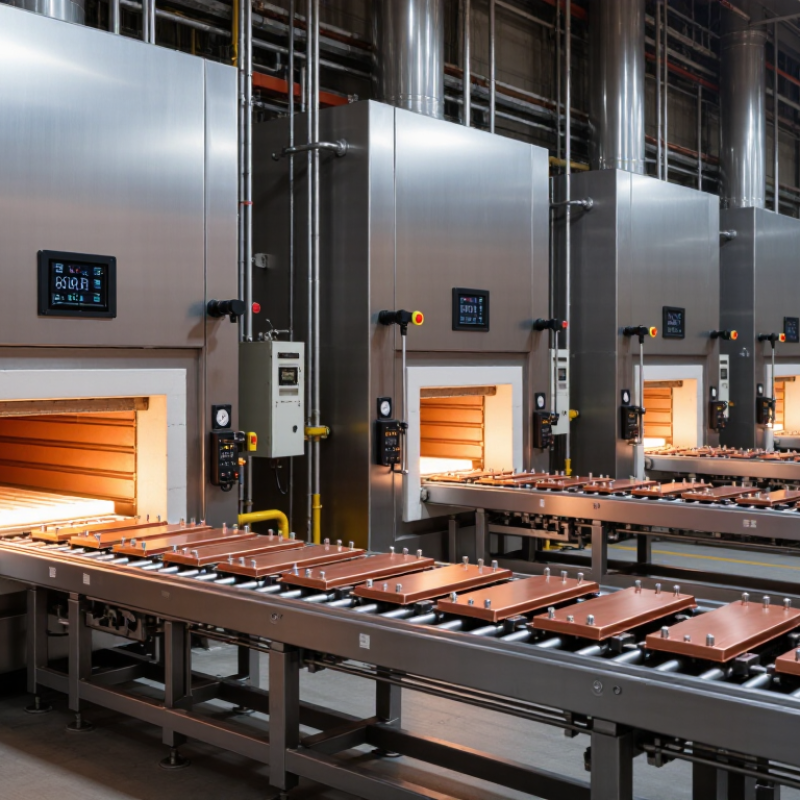
China Top Copper Brazing Furnace Manufacturers and Suppliers

Copper Brazing Defined: Filler Metals Have a Liquidus Above 450°C

Copper brazing uses a filler metal whose liquidus temperature is above 450°C. Liquidus is the point at which the filler is fully liquid, not merely soft or partly molten. The copper parts usually remain solid while the filler flows into the joint. This distinction separates brazing from lower-temperature soldering.

A close, clean joint helps molten filler travel through the gap by capillary action. Oxide, oil, or an uneven clearance can interrupt that flow and leave a weak spot. In a furnace, operators control heating rate, peak temperature, and atmosphere to limit oxidation and encourage even wetting. Small temperature differences matter. A thermocouple near the workpiece can reveal conditions that a furnace setting alone may miss.

Filler selection depends on service temperature, joint design, and the copper components being joined. The filler’s melting range and compatibility should be checked against technical data, then confirmed with a representative trial. In practice, charts do not replace a trial joint. It is easy to overlook how a slightly different gap changes filler flow, especially on thin tubing or compact assemblies. Factory results can vary, so process records and inspection remain useful.

Furnace Types and Protective Atmospheres for Copper Brazing

Copper brazing furnaces are commonly configured as batch, continuous mesh-belt, or vacuum systems. Each suits different production needs. Batch furnaces handle varied part sizes and small runs, while mesh-belt lines provide steady throughput for repeatable assemblies. Vacuum furnaces limit oxidation without relying on a flowing process gas, but joint design and filler-metal behavior still need careful trials.

Protective atmospheres matter because copper oxide can prevent filler metal from wetting the joint. Dry nitrogen-hydrogen mixtures are used for many applications, while hydrogen-rich atmospheres require suitable controls and trained operation. The correct choice depends on copper grade, filler alloy, part cleanliness, and furnace temperature. Small details matter. A clean, dry atmosphere alone cannot compensate for oily surfaces or uneven heating.

For reliable results, monitor atmosphere dew point, gas flow, and temperature uniformity near the work zone. A practical trial can include witness coupons and inspection of joint fill after brazing. Some assemblies still show inconsistent results, even with stable furnace settings; that is a reason to review fit-up, clearances, and heating profiles rather than assume the furnace is at fault.

Temperature Control: Pure Copper Melts at 1,084.6°C

Pure copper melts at 1,084.6°C under standard pressure, but a furnace display does not guarantee an even melt. Heat moves through the load gradually, and tightly packed copper pieces may warm at different rates. A thermocouple near the heating element can show a different temperature from the center of the charge. Small details matter. Sensor placement, calibration, and furnace loading all affect the reading. That gap matters.

For copper brazing, temperature control helps protect joint quality and limit overheating. The required setting depends on the filler metal, joint design, and process conditions; it is not simply the copper melting point. Suppliers should explain how their equipment measures temperature and manages fluctuations near the working zone. Ask about sensor locations, calibration procedures, and temperature uniformity across the chamber. A stable control system can reduce uneven heating, though it cannot correct poor setup by itself. Operators should compare recorded readings with actual process results. Precision on a screen is useful, but it can create false confidence when the load is not positioned consistently. A practical trial with representative parts may reveal issues that a specification sheet misses.

China Top Copper Brazing Furnace Manufacturers and Suppliers - Temperature Control: Pure Copper Melts at 1,084.6°C

Technical comparison guide for evaluating copper brazing furnace suppliers. The process figures below are general guidance, not specifications for a particular furnace or supplier.

Evaluation Dimension Relevant Data or Common Options What Buyers Should Confirm with Suppliers
Pure copper melting point Pure copper melts at 1,084.6°C under standard pressure. Use this as a reference for avoiding base-metal melting; it is not the recommended brazing setpoint.
Brazing temperature The filler metal must reach its specified liquidus temperature while the copper components remain solid. The required temperature depends on the filler alloy and joint design. Request the filler-metal data sheet and agree on the process setpoint, heating profile, and allowable temperature variation.
Furnace configuration Common options include batch furnaces for varied or lower-volume work and continuous furnaces, such as mesh-belt systems, for repeatable production. Compare usable work-zone dimensions, loading method, throughput, and suitability for the component’s size and production volume.
Atmosphere and surface protection Depending on the parts and filler, brazing may use a controlled atmosphere, vacuum, or suitable flux. Atmosphere selection affects oxidation control and surface cleanliness. Confirm the proposed atmosphere, gas purity and consumption, oxygen or dew-point monitoring, and any flux-removal requirements.
Temperature measurement and uniformity Thermocouples provide temperature feedback; actual workpiece temperature can differ from the controller reading. Uniformity depends on furnace design, loading, and operating conditions. Ask for the guaranteed work-zone uniformity, measurement method, calibration plan, and temperature profile under a representative load.
Heating and cooling cycle Cycle time is affected by part mass, load arrangement, furnace type, setpoint, and cooling requirements; no single cycle time applies to every copper assembly. Request a trial or documented cycle using parts representative of the intended production load.
Joint quality and process control Brazed joint quality depends on joint clearance, cleanliness, filler placement, heating, and cooling—not furnace temperature alone. Discuss process records, alarm limits, repeatability, sample-part trials, and inspection criteria for the finished joints.
Safety and utilities Electrical demand, exhaust needs, and gas-system requirements vary by furnace and atmosphere. Hydrogen-containing atmospheres require appropriate safety systems. Obtain utility requirements, ventilation details, gas safeguards, emergency procedures, and applicable safety documentation.
Supplier documentation and support Useful documentation includes a technical specification, operating manual, electrical drawings, maintenance schedule, and commissioning plan. Confirm installation and training support, spare-parts availability, warranty terms, and service response arrangements.

Key Supplier Metrics: Temperature Uniformity, Throughput, and Energy Use

China Top Copper Brazing Furnace Manufacturers and Suppliers

Key Supplier Metrics: Temperature Uniformity, Throughput, and Energy Use

For copper brazing, stable heat matters more than a high maximum temperature. Ask suppliers for temperature-uniformity data from a fully loaded furnace, not just an empty chamber. Confirm where sensors were placed and whether the test used your part size and fixture layout. Even a small hot spot can affect joint flow and consistency. Request sample-run records where possible. A neat chart alone is not enough.

Throughput depends on the complete cycle: loading, heating, brazing, cooling, and unloading. Compare cycle times using similar part quantities and loading patterns. Ask how quickly the furnace recovers after the door opens, if that applies to your process. Energy use should be measured against usable output, such as kilowatt-hours per batch or part. Check standby consumption and insulation condition too. A quoted efficiency figure may hide assumptions that do not match your shop.

Tips: Share representative parts and production volumes before requesting a quote. Ask for a test run, operating data, and maintenance intervals. Leave room for doubt: real shifts rarely follow a perfect schedule, and supplier figures may need independent verification.

China Supplier Evaluation: Certifications, Applications, and After-Sales Support

China-based copper brazing furnace suppliers should be evaluated on quality systems, process records, and service capacity. The IEA’s Global Critical Minerals Outlook 2024 projects copper demand rising from 26.7 million tonnes in 2023 to 31.1 million tonnes in 2035 under its Stated Policies Scenario. This growth increases the value of consistent joints and controlled heating. Small details matter.

Ask for current ISO 9001 certification and confirm that any CE documentation applies to the model and destination market. Certifications do not prove process performance. Request sample temperature-uniformity records, operating instructions, and references for comparable applications. Common uses include copper tube fittings, heat exchangers, and electrical connectors. A useful factory visit checks loading access, atmosphere controls, and the actual furnace cycle—not only the showroom unit.

After-sales support should be specific. Confirm commissioning, operator training, spare-part lead times, and response arrangements for thermocouples or control-system faults. Ask how service cases are recorded and resolved. Even a thorough audit can miss problems that appear after installation; that deserves attention. A supplier’s written service commitments are more useful than broad promises, though response times may still vary with location and parts availability.