Contact us

China Top 10 LED Strip Lighting Manufacturers

LED strip lighting has moved from decorative accent to a practical tool for homes, retail displays, hospitality spaces, and architectural details. Its appeal is easy to see: a slim flexible strip can tuck beneath a kitchen cabinet, trace a shelf edge, or wash a textured wall with light. But product quality varies. Brightness, color consistency, heat management, dimming compatibility, and adhesive performance can differ sharply between suppliers.

The International Energy Agency’s 2023 lighting analysis tracks the continuing shift toward efficient LED technology worldwide. That broader transition matters to strip buyers, but efficiency alone does not tell the whole story. A reliable comparison also needs to examine test methods, control options, warranty terms, and the support behind each product. The U.S. Department of Energy notes that LED performance depends on the complete lighting system, not only the light source. A useful reminder.

This guide to China’s top 10 LED strip lighting manufacturers is designed to help readers assess those details with care. Lighting scientist Dr. Ian Ashdown’s work on visual perception offers a valuable lens: lighting should be judged in its real setting, not by specifications alone. That is not a substitute for verified product testing. It is a reason to ask better questions. Which manufacturers publish clear technical data? Which can provide consistent samples, documented quality controls, and responsive engineering support? The answers matter. A strip that looks vivid in a catalog may appear uneven across a long kitchen run. This list aims to make supplier research more grounded, while recognizing that rankings and product suitability can change over time.
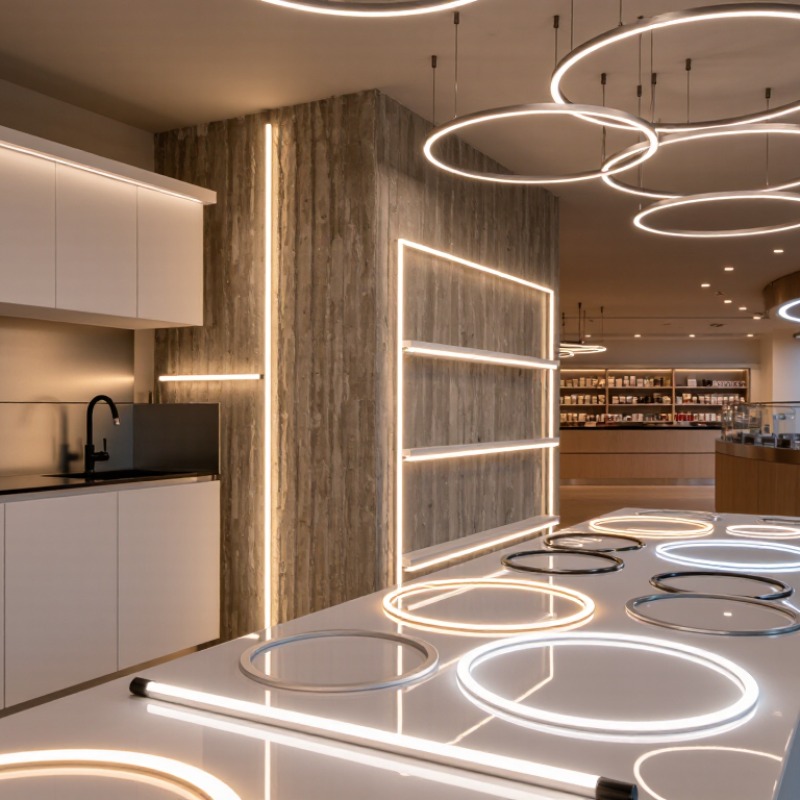
China Top 10 LED Strip Lighting Manufacturers

How China’s LED Strip Lighting Industry Is Structured

China’s LED strip lighting industry is built from specialized suppliers, assembly factories, and export-oriented trading teams. It is a network, not one uniform manufacturing model. Upstream suppliers provide LED chips, flexible circuit boards, resistors, and protective coatings. Strip manufacturers combine these parts, then cut, solder, test, and package the finished reels.

Some factories focus on high-volume standard strips, while others handle custom layouts, colors, or silicone-jacketed products. Power supplies may come from separate vendors, so the strip and driver do not always share the same quality controls. That division can make sourcing flexible. It can also make responsibility less clear when a system flickers or runs hot.

Testing details matter. A practical review might check color consistency between reels, solder joints under magnification, and voltage drop across a five-meter sample. Ask how the factory verifies brightness, color temperature, and water resistance, rather than relying on a label alone. Specifications can look precise. Production batches still vary. The industry’s structure is efficient, but its boundaries are sometimes messy; buyers should confirm which company controls each critical step.

Criteria for Evaluating LED Strip Lighting Manufacturers

Choosing an LED strip lighting manufacturer takes more than comparing price and advertised brightness. Request measurable specifications, including lumens per meter, color temperature tolerance, color rendering index, and voltage drop across a stated length. Ask how the manufacturer checks consistency between production batches. A strip that looks even on a short sample may show color shifts across a full installation.

Tips: Request samples from the intended production range. Test them at the planned length, voltage, and operating temperature. Check whether the adhesive holds on a clean aluminum channel. Ask for written test methods, inspection records, and clear warranty terms. Keep the answers.

Also evaluate thermal design and protection ratings against the actual installation environment. For outdoor use, ask how the finished strip and connectors are tested for moisture resistance; a rating on one component may not cover the whole assembly. Confirm lead times and whether replacement parts remain available. I would treat any sample as a snapshot, not a promise: production can drift, and paperwork alone cannot reveal every issue. A careful supplier should explain limits plainly and provide documents that match the offered product.

China Top 10 LED Strip Lighting Manufacturers - Criteria for Evaluating LED Strip Lighting Manufacturers

A practical 100-point evaluation framework. The weights are suggested assessment criteria, not verified scores or rankings of specific manufacturers.

Evaluation criterion Weight What to evaluate Evidence to request
Product safety and compliance 18% Whether the offered strip, power supply, and intended installation have appropriate safety documentation for the destination market. Relevant standards depend on product design and application. Current test reports and declarations for the exact model; check applicability of standards such as IEC 62031 for LED modules, IEC 60598-1 for luminaires, and IEC 60529 for IP enclosure ratings.
Photometric and electrical specifications 15% Accuracy and completeness of stated input voltage, power per metre, current, luminous flux, color temperature, color rendering, and operating conditions. Model-specific datasheets and test results identifying measurement conditions, tolerances, and whether values refer to the strip alone or a complete system.
Color consistency and binning 10% Consistency of color temperature and chromaticity between production batches, reels, and replacement orders. Documented chromaticity or CCT tolerances, binning policy, sample measurements, and batch traceability records.
Thermal design and lifetime support 10% Thermal management guidance and the technical basis for any lifetime or lumen-maintenance claims. LED package data should not be treated as a direct guarantee of complete-strip life. Recommended operating temperatures, installation and heat-sinking guidance, warranty terms, and applicable LED-package maintenance data or projections, such as LM-80 data and TM-21 calculations where relevant.
Environmental protection and durability 10% Suitability of the strip construction, coating, connectors, and installation method for the stated indoor or outdoor environment. IP test documentation where an IP rating is claimed, plus clear limits for exposure, sealing, connectors, cutting, and installation. IP ratings describe specified ingress protection, not general product durability.
Quality management and production controls 10% Consistency of incoming-material checks, in-process inspection, final testing, nonconformance handling, and change control. Quality-management certificates with scope and validity verified, inspection procedures, sample quality records, and written notification procedures for material or design changes.
Customization and engineering capability 8% Ability to support requested PCB widths, LED density, CCT, control options, reel length, connectors, and packaging without obscuring design limitations. Written feasibility review, approved drawings or samples, change-control details, and confirmation of minimum order quantities and lead times.
Sampling and pre-shipment inspection 7% Whether representative samples can be evaluated before order approval and whether agreed specifications are checked before shipment. Sample approval process, inspection checklist, acceptance criteria, and sample or inspection reports tied to the production lot.
Traceability and documentation 6% Ability to link shipped products to model revisions, production batches, component records, and relevant test documents. Lot or date codes, revision-controlled datasheets, batch records, and a documented process for handling technical inquiries and quality complaints.
Commercial reliability and after-sales support 6% Clarity and consistency of quotations, delivery commitments, warranty coverage, replacement procedures, and technical support. Written quotation and warranty terms, stated lead-time assumptions, escalation contacts, and documented procedures for returns or corrective action.
Total suggested evaluation weight 100% Score each criterion using verified, model-specific evidence; compare suppliers only after confirming that products are being assessed on equivalent specifications and intended applications.

Profiles of China’s Top 10 LED Strip Lighting Manufacturers

Profiles of China’s top ten LED strip lighting manufacturers are most useful when they explain production strengths, not just product ranges. The International Energy Agency’s Tracking Clean Energy Progress 2023 reports that LEDs accounted for about half of global lighting sales in 2022. That shift raises expectations for efficiency, heat management, and consistent light output, including in flexible strips. Buyers should look for clear evidence behind each manufacturer’s claims.

A useful profile compares engineering and factory capabilities: available color temperatures, color-rendering performance, voltage options, and protection against dust or moisture. It should also explain how the maker controls brightness along a reel. A five-metre strip may appear dimmer at its far end if voltage drop is poorly managed. Ask whether product specifications apply to a tested sample or the full production run. Small details matter.

The ten profiles can distinguish high-volume suppliers from manufacturers focused on custom lengths, coatings, or lighting controls. Check for dated test reports, traceable quality procedures, and practical support with sampling. A polished catalogue is not proof of reliable output. Rankings are imperfect. The IEA figure describes the wider lighting market, not LED strips alone, so it should not be treated as a strip-specific sales statistic.

Comparing Product Range, Technology, and Production Capabilities

China Top 10 LED Strip Lighting Manufacturers
Comparing Product Range, Technology, and Production Capabilities

Comparing manufacturers starts with the range of products they can supply. Check available widths, color temperatures, brightness levels, and waterproof options. A varied catalog can simplify sourcing for projects that use both indoor coves and outdoor signage. But catalog size alone proves little. Request current specifications and confirm that listed options are regularly produced.

Technology affects light quality and installation. Ask about color consistency, dimming compatibility, heat management, and performance across long runs. Review sample strips under the same power supply and compare brightness near the start and end. Look closely. Small differences can matter in a continuous ceiling line. Clear test data helps, though a data sheet cannot replace a physical sample.

Production capability is just as important as product choice. Discuss monthly capacity, quality checks, lead times, and how the factory handles custom lengths or connectors. Ask how defects are recorded and whether replacement batches can match earlier orders. These details reveal more than a polished showroom. Still, comparisons are not always straightforward: factories may use different test conditions, and buyers can overlook installation needs when focusing on price. A practical assessment weighs documentation, samples, communication, and repeat-order consistency together.

How to Choose a Chinese LED Strip Lighting Supplier

China Top 10 LED Strip Lighting Manufacturers

Choosing a Chinese LED strip lighting supplier takes more than comparing unit prices. Start with the product details: voltage, LED density, color temperature, width, copper weight, and intended installation environment. Ask for a sample reel and check whether brightness and color remain consistent from the first meter to the last. A specification sheet is useful, but it cannot replace a hands-on test.

Tips: Request recent test reports, written warranty terms, and details about incoming-material and final-inspection checks. Confirm whether the supplier can provide the required documentation for your target market, then verify it independently. Ask how the supplier handles component substitutions, production delays, and defective batches. Put agreed specifications in the purchase contract, including color tolerance and packaging requirements.

Compare quotations on equal terms. A lower price may reflect a shorter warranty, different LEDs, or a smaller copper circuit; clarify before deciding. Check production capacity and lead times against your order size, and ask for dated production photos or inspection records when appropriate. Communication matters, too: clear answers about technical limits are more useful than broad promises. Still, no checklist removes every risk. A small trial order can reveal issues that polished sales materials may not.