China Top 10 Portable Milk Frother Manufacturers?
Choosing a Portable Milk Frother supplier in China involves more than comparing product photos or advertised prices. Buyers may need to assess motor performance, whisk durability, battery options, noise, packaging, and consistency between samples and production units. Small details matter. A frother that works well in a short demonstration may behave differently after repeated use, so practical testing is worth the time.
This guide introduces ten manufacturers for buyers who are researching sourcing options, private-label products, or custom designs. It considers factors such as product range, manufacturing experience, quality-control practices, customization support, sample availability, and communication. These details can help narrow a shortlist, but they should not replace direct checks. Request current specifications, clarify minimum order quantities and lead times, and test samples under realistic conditions. Ask how defects are handled, too. That conversation can reveal gaps that a polished catalog will not show.
Supplier information can change, and manufacturer claims are not independent verification. Confirm company details and relevant product documentation before making a purchasing decision. Some suppliers may suit large orders, while others may offer more flexibility for smaller projects. There is no perfect match for every buyer. The following overview is a starting point for comparing China’s Portable Milk Frother manufacturers with clearer expectations and fewer assumptions.
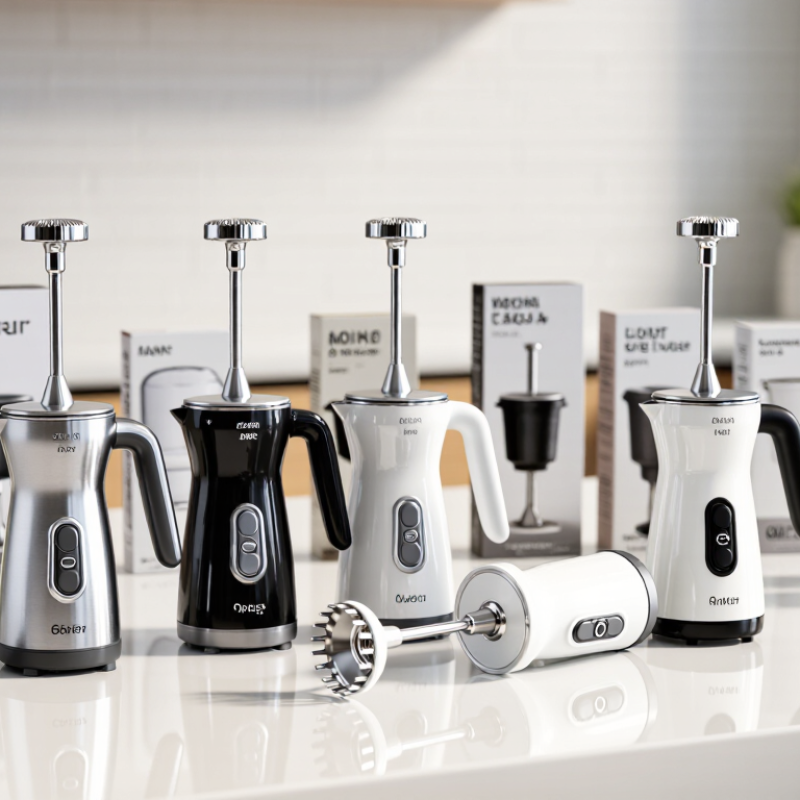
What Is a Portable Milk Frother and How Is It Made?
A portable milk frother is a small, handheld tool that whips air into milk to create foam. It usually has a compact motor, a narrow metal shaft, and a looped whisk at the tip. A button starts the motor, which spins the whisk quickly. Unlike a steam wand, it does not heat milk; users warm the milk separately if they want a hot drink. That distinction matters. Cold milk, milk temperature, and the whisk’s depth can all affect the foam.
Production begins with shaping the outer housing and forming the stainless-steel whisk and shaft. The motor, switch, battery contacts, and other components are then fitted inside the handle. Workers or automated equipment connect and inspect the parts before the housing is closed. Each unit should be tested for startup, steady rotation, unusual vibration, and battery operation. A quick foam test can reveal problems that a visual check might miss. The design is simple, but simple does not mean foolproof. A loose shaft can wobble, while a poorly sealed handle may be difficult to clean safely. Materials, assembly tolerances, and repeatable testing all influence how the frother feels and performs in everyday use.
China Top 10 Portable Milk Frother Manufacturers? - What Is a Portable Milk Frother and How Is It Made?
A portable milk frother is a handheld, usually battery-powered appliance that uses a small rotating whisk to aerate milk. This table is a general guide to common product features and manufacturing steps; it is not a ranked list of manufacturers or a specification for any particular model.
| No. | Product or manufacturing aspect | Typical details | Why it matters |
| 1 | Core function | A compact motor spins a wire whisk to incorporate air into milk or other suitable liquids. | Defines the appliance’s basic use: creating foam or mixing drinks. |
| 2 | Housing | Commonly molded from engineering plastics; some designs use a stainless-steel outer shell. | The casing protects internal parts and affects grip, durability, and appearance. |
| 3 | Whisk and shaft | The shaft and spring-style whisk are commonly made from food-contact stainless steel. | Material choice helps with corrosion resistance and routine cleaning. |
| 4 | Motor and drive | A small electric motor transfers rotation to the whisk through a shaft or coupling. | Motor performance and alignment influence mixing consistency, noise, and vibration. |
| 5 | Power supply | Portable models may use replaceable batteries or a rechargeable battery with USB charging. | The power design affects portability, charging needs, and ongoing battery replacement. |
| 6 | Controls and electronics | A basic model may use a single switch; some rechargeable models include speed settings or a charging indicator. | Controls should be easy to operate and protected from accidental liquid exposure. |
| 7 | Part production | Plastic housings are typically injection-molded; metal shafts and whisks are formed and finished separately. | Consistent dimensions help parts fit together and support reliable assembly. |
| 8 | Assembly | Workers or assembly equipment fit the motor, drive parts, power components, switch, and housing, then attach the whisk. | Correct assembly supports stable operation and secure attachment of moving parts. |
| 9 | Quality checks | Typical checks can include on/off operation, charging or battery function, whisk alignment, and visual inspection. | Testing can identify assembly faults before products are packed. |
| 10 | Packaging and documentation | Packaging commonly protects the appliance and may include operating, cleaning, and charging or battery instructions. | Clear instructions help users operate and care for the product appropriately. |
China’s Portable Milk Frother Manufacturing Industry
China’s portable milk frother manufacturing industry brings together metalworking, plastic molding, motor assembly, and small-appliance testing. Many manufacturers can source stainless-steel whisk heads, battery compartments, switches, and packaging through established supply networks. That proximity can help shorten development cycles, though actual lead times depend on component availability and order size. Small tools, tight tolerances.
Product design often balances foam quality with portability. A compact motor must spin fast enough to create a smooth texture without draining batteries too quickly. Engineers also need to consider handle weight, splash control, and how easily the whisk detaches for cleaning. These details matter in daily use: a loose battery cover or a bent whisk can make an otherwise attractive device frustrating. Testing should include repeated starts, different milk temperatures, and checks for vibration or unusual noise.
Manufacturing quality is not uniform across suppliers. Buyers can ask for sample units, material specifications, inspection records, and clear acceptance criteria before placing larger orders. A sample can reveal finish and handling, but it cannot prove long-term durability on its own. That gap deserves attention. Packaging, spare-part planning, and communication about design changes also affect the final product. The industry offers flexible production options, yet consistency still depends on careful process control and transparent verification.
Criteria for Identifying Leading Chinese Manufacturers
Criteria for identifying leading Chinese portable milk frother manufacturers should go beyond polished product photos. Check whether the factory controls motor assembly, shaft alignment, battery testing, and food-contact material traceability. Ask for test records showing foam consistency across different milk temperatures, plus inspection results from recent production batches. A sample that works once proves little. Repeat the test.
The ISO Survey 2022 reported more than 1.26 million ISO 9001 certificates worldwide. This indicates broad adoption of quality-management systems, but it does not certify a frother’s safety or performance. Verify the certificate’s scope and issuing body. Then compare factory audit findings, defect records, warranty handling, and production capacity with your order requirements. Numbers need context. Strong suppliers can explain failures, not just display certificates.
Tips: Request three samples from separate batches. Time each frothing cycle, inspect the whisk for wobble, and record battery performance after repeated use. Ask who performs the tests and how results are documented. A spreadsheet is helpful, though it cannot replace an independent inspection.
Profiles of 10 Chinese Portable Milk Frother Manufacturers
China’s portable milk frother sector includes factories with different strengths, from compact motor assembly to stainless-steel whisk production. The profiles below describe ten supplier capabilities to compare, not verified rankings of named companies. Ask each factory for current specifications and sample results.
Profile 1 focuses on slim, lightweight housings for travel. Profile 2 specializes in rechargeable models with USB charging. Profile 3 emphasizes replaceable whisk heads and simple cleaning. Profile 4 produces battery-powered units for basic, low-cost use. Profile 5 offers several speed settings for different milk textures. Profile 6 concentrates on quiet motors for home kitchens. Profile 7 supports custom colors and packaging. Profile 8 makes food-contact components and provides material documentation. Profile 9 handles small production runs for emerging buyers. Profile 10 offers larger-volume assembly and routine quality checks.
Useful details matter more than polished sales claims. Check whisk alignment, switch feel, charging consistency, and foam after a short test. Ask how the supplier checks motor performance across a batch. A sample can look good, then behave differently after repeated use. No factory is perfect. Buyers should compare evidence, clarify what is included, and confirm that production matches the approved sample.
How to read this chart: Keep milk refrigerated at 0–4°C. For frothing, a commonly recommended warming range is about 55–65°C; temperatures above 70°C may overheat the milk. These are general preparation guidelines, not manufacturer-specific product data.
How to Compare Manufacturers and Verify Their Capabilities
Comparing portable milk frother manufacturers starts with the product, not the catalog. Check whisk speed, battery type, charging method, handle weight, and cleaning instructions. Ask whether the frother can create consistent foam with both cold and warm milk. Request samples made with the same materials and production process as standard orders. Test them yourself. A showroom sample may not reflect everyday manufacturing.
Look for evidence behind capability claims. Request documented inspection steps, material specifications, and sample test records. Ask how the factory checks motor performance, charging safety, noise, and water exposure around the whisk head. These details matter. A clear answer should include test methods and acceptance limits, not only phrases such as “strict quality control.” If possible, compare pre-production samples with goods from a later production run.
Production capacity also deserves careful checking. Discuss monthly output, lead times, minimum order quantities, and how defects are handled. A video call can show equipment and workflow, but it cannot replace a site visit or independent inspection. Be cautious when records are incomplete or answers keep changing. I would also ask for references from comparable product projects, while recognizing that confidentiality may limit what a manufacturer can share. No single check proves reliability; several consistent pieces of evidence are stronger.
