Contact us

Why Choose Industrial Cables for Your Business?

A factory rarely gives its cables an easy life. They may run beside vibrating motors, pass through warm equipment rooms, or face oil, moisture, and repeated movement. Industrial Cables are designed for demanding operating conditions, but no single cable suits every site. Small details matter. A jacket that performs well indoors may not be appropriate outdoors, while a cable’s flexibility can affect installation around moving machinery.

For a business, choosing suitable cables can support dependable power and signal transmission, reduce avoidable maintenance, and help equipment operate as intended. The decision deserves more than a quick price comparison. Teams should check voltage and current requirements, temperature range, installation method, shielding needs, and compatibility with connected equipment. Specifications and site conditions should guide the choice, with qualified electrical professionals involved where needed. Not every project has a perfect answer. Even experienced teams may need to revisit assumptions when equipment layouts or operating conditions change.

This guide explores why businesses choose Industrial Cables and which practical factors deserve attention before purchasing. It considers durability, performance, safety, and long-term operating costs without treating any product as a universal fix. A careful selection process can make a real difference. It can also reveal trade-offs: a tougher construction may cost more or be less flexible. The useful question is not simply, “Which cable is strongest?” It is, “Which cable fits this application, and how will we verify that?”
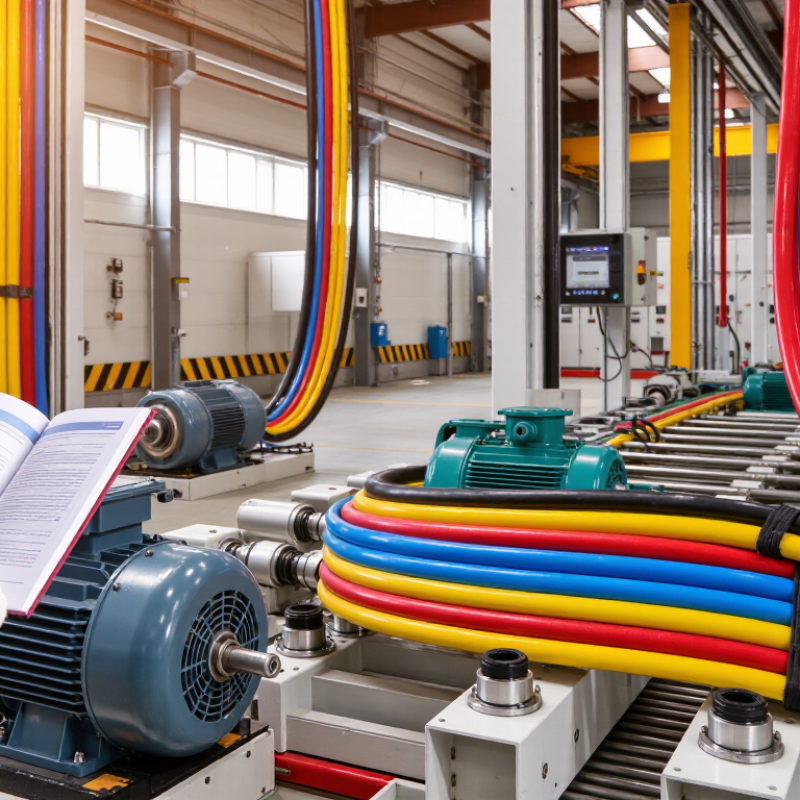
Why Choose Industrial Cables for Your Business?

Industrial Cables Explained: Conductors, Insulation, and Voltage Ratings

Industrial cable selection starts with the conductor and its working conditions. Copper carries current efficiently and bends readily, while aluminum weighs less. Its larger size can complicate routing. A crowded cable tray above a motor may need flexible cables and careful support. Small details matter.

Insulation separates conductors and helps protect them from heat, moisture, abrasion, and chemicals. PVC suits many general installations; XLPE often handles higher temperatures and demanding service. Neither material is universally best. A cable near hot machinery or exposed to oil needs insulation suited to actual conditions, not just a familiar label. Check temperature ratings and installation guidance.

Voltage rating describes the electrical stress a cable is designed to withstand. It must suit the system and its terminations. For example, a 600-volt cable is not automatically appropriate for every 480-volt installation; ambient heat, bundling, and other conditions affect performance. Verify conductor size, allowable current, and voltage rating against equipment documentation and the cable datasheet. Easy to overlook. Even a sound specification deserves a second look when site conditions differ from the assumptions.

IEC 60228 Conductor Classes: From Class 1 Solid to Class 6 Flexible

IEC 60228 classifies conductors by construction, helping businesses match cable to installation conditions. Class 1 uses a single solid conductor, often suited to fixed wiring in protected routes. Class 2 uses stranded conductors, which can be easier to handle during installation while remaining intended for fixed applications. Check the cable and equipment specifications together.

Class 5 conductors use finer strands for greater flexibility, while Class 6 is more flexible still. That can help when routing cable through tight equipment spaces or connecting components that move during normal operation. Fine strands need suitable terminals and careful preparation. A flexible conductor alone does not make a cable suitable for continuous movement.

More flexibility is not automatically better. It may add cost or require different termination practices, and the class does not define the cable’s complete performance. I’d compare the conductor class with the bend radius, installation method, current requirements, and terminal design. Small details matter: a cable that fits neatly around a machine frame may still be wrong for its connector. Check the datasheet before ordering.

Choosing Voltage Ratings: Common 0.6/1 kV and 18/30 kV Cable Classes

Why Choose Industrial Cables for Your Business?

Choosing Voltage Ratings: Common 0.6/1 kV and 18/30 kV Cable Classes

Voltage rating should match the circuit, equipment, and installation conditions—not just the nearest number on a specification sheet. A 0.6/1 kV cable is commonly used in low-voltage power distribution, such as feeding machinery or lighting panels. An 18/30 kV cable serves medium-voltage systems, including industrial substations and distribution feeders. Under IEC 60502, these classes fall within separate cable requirements. That distinction matters.

The International Energy Agency’s 2023 report, Electricity Grids and Secure Energy Transitions, says annual grid investment must rise to more than USD 600 billion by 2030 to meet global needs. For businesses, expanding or upgrading electrical infrastructure makes correct cable selection especially important.

Check the system’s nominal voltage, insulation level, fault conditions, and installation environment. A 30 kV class cable is not automatically suitable for every medium-voltage network; confirm the required U0/U and Um ratings with the project engineer. I have seen specifications overlook ambient heat. It is an easy detail to miss.

Tips: Verify the cable class against the equipment and protection design before ordering. For an 18/30 kV circuit, check whether the network’s highest voltage aligns with the cable’s Um rating, typically 36 kV. Also confirm conductor size, screen construction, and termination compatibility. When drawings conflict, pause and clarify them.

Sizing for Load: IEC 60287 Current-Rating Calculations

Industrial cable sizing is not a catalogue guess. It is a thermal calculation. The IEA’s 2023 report, Electricity Grids and Secure Energy Transitions, says annual grid investment needs to exceed USD 600 billion by 2030. As networks expand, accurate cable ratings help prevent both overheating and unnecessary oversizing.

IEC 60287-1-1 calculates steady-state current capacity from conductor losses and heat flow. The inputs include conductor resistance at operating temperature, AC effects, sheath and armour losses, and insulation losses where relevant.

Installation details matter just as much: ambient temperature, burial depth, soil thermal resistivity, ducts, and nearby loaded circuits can change the result. A cable buried in dry backfill may shed heat less effectively than one in moist soil. Small details count.

Start with the real load profile, not only the nameplate value. Then check installation data and assumptions against site conditions. IEC 60287 provides a calculation method, not a substitute for verified inputs or engineering review.

One point deserves a second look: soil conditions can vary along a route, while calculations often simplify them. For cyclic or emergency loading, assess the duty separately; a steady-state rating alone may not describe it.

Fire Performance: What IEC 60332 Flame-Spread Tests Measure

Industrial cable selection is not only about current capacity or abrasion resistance. Fire performance matters when cable runs pass through control rooms, production lines, and crowded trays. IEC 60332-1-2 tests a single vertical cable with a 1 kW premixed flame. It measures whether flame spreads beyond the standard’s permitted limit after exposure. For cable groups, the IEC 60332-3 series uses vertical-tray tests, with defined cable loading and test conditions. These results help compare flame-spread performance, but a single-cable test cannot predict how a dense installation will behave.

The stakes are real. The NFPA report Fire Loss in the United States During 2023 estimates 3,670 civilian fire deaths that year; this figure covers fires broadly, not cable-related incidents alone. A test certificate should therefore be read alongside the exact IEC test method, cable construction, and installation conditions. Ask whether the tested sample represents the cable you plan to buy. Check the report itself. Still, a pass is not a promise. IEC 60332 tests assess flame spread; they do not, by themselves, establish low smoke, low toxicity, or circuit survival during a fire. That distinction is easy to miss when a specification says only “flame-retardant.”

Why Choose Industrial Cables for Your Business?

Fire Performance: What IEC 60332 Flame-Spread Tests Measure

IEC 60332-3 tests assess flame spread along vertically mounted, bunched cables. The chart shows the specified flame exposure time for each category; the categories also differ in the volume of non-metallic material tested per metre of cable tray. A longer exposure time alone does not indicate a better or worse result: cables must meet the applicable test’s pass criteria. Select cables tested to the standard and category appropriate for your installation.