Contact us

How to Choose the Best Solar Motion Flood Light?

Outdoor security lighting is becoming more accessible as solar power expands, but a bright product photo proves very little. Choosing a Solar Motion Flood Light means balancing useful brightness, dependable sensing, battery capacity, and sunlight exposure. The right choice should illuminate a gate, driveway, or garden path when needed—not merely look powerful on a product page. Small details matter.

IRENA’s Renewable Capacity Statistics 2024 reports that global solar capacity grew by about 346 gigawatts in 2023. This figure describes the energy sector, not the performance of individual lights, but it shows how rapidly solar technology is scaling. The U.S. Department of Energy notes that LED lighting uses at least 75% less energy than incandescent lighting. That comparison offers useful context, not a guarantee that every solar floodlight will shine brightly all night. Weather, shade, battery condition, and sensor settings all affect real-world results.

This guide explains how to compare lumen ratings, motion-detection range, sensor angle, battery specifications, and weather-resistance claims. It also considers where the panel will sit: a south-facing, sunlit wall may perform differently from a shaded corner beneath an eave. Check whether the light allows adjustable brightness and detection time. Those controls can help conserve stored energy. One point deserves skepticism: advertised runtime often reflects ideal test conditions. A clear specification is helpful; an independent test is better.
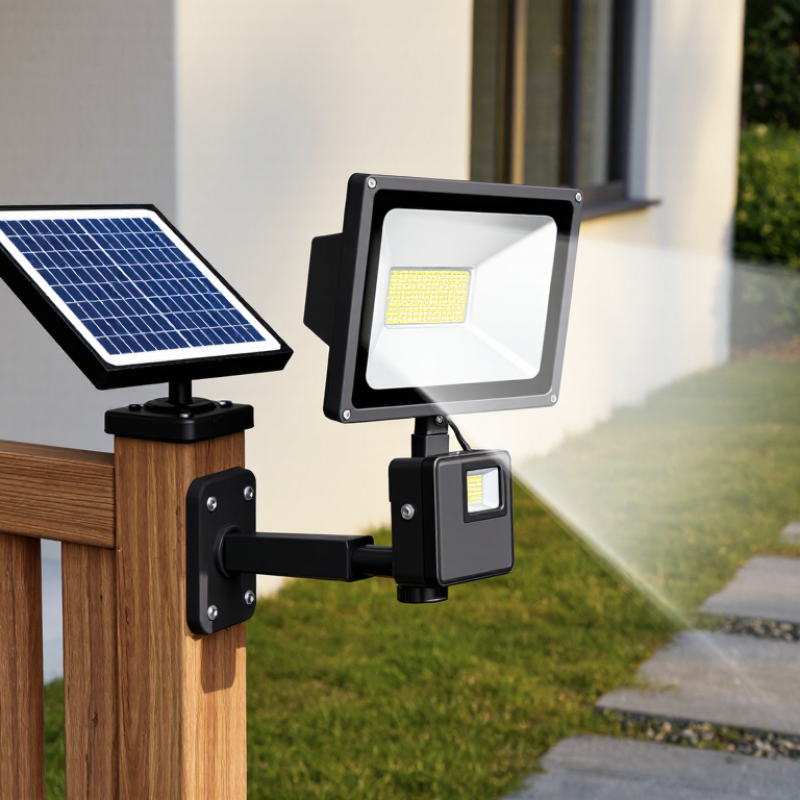
How to Choose the Best Solar Motion Flood Light?

Understanding How Solar Motion Flood Lights Work

A solar motion flood light works as a compact, off-grid lighting system. In daylight, photovoltaic cells convert sunlight into electricity, while a charge controller directs power into a rechargeable battery. At dusk, a photocell enables the light’s motion-sensing mode, which uses little power while waiting for activity.

A passive infrared sensor detects changes in infrared energy, such as a person moving through its detection zone. When triggered, the control circuit sends battery power to the LED array for a set period. The lamp then dims or switches off until it detects movement again. That cycle saves energy. Detection is not exact, though: passing branches, nearby warm surfaces, or a poorly aimed sensor can cause unwanted activation or missed movement.

Performance depends on charging conditions as well as sensor design. A panel shaded by eaves or winter tree cover may not recharge the battery fully, even if the lamp still turns on. Place the panel where it gets several hours of direct sunlight, and aim the sensor across a path rather than directly toward it. Check whether the panel is attached to the light or connected by a cable; a separate panel can help in a shaded spot. It is tempting to judge a light by brightness alone. Runtime matters too.

Assessing Your Lighting Area and Security Needs

Begin with the places that need light, not the fixture’s advertised brightness. Walk the property after dark and mark doors, side paths, garage approaches, and shadowed corners. Note where a person might approach unseen. A simple sketch helps. Small details matter.

Next, check the distance and width each light must cover. A narrow beam may leave a gate or walkway dark, while a broad beam can spill into a neighbor’s window. Motion sensors also need a clear view; shrubs, parked cars, and passing traffic can trigger them. Consider how often people use the area, and whether a sudden bright beam would help someone navigate or merely cause glare.

The U.S. Department of Energy’s outdoor-lighting guidance recommends directing light only where it is needed and avoiding unnecessary glare. Practical, but easy to overlook.

Security lighting can support visibility, but it is not a guarantee. A 2015 Campbell systematic review examined 13 studies of improved street lighting and reported a 21% reduction in crime in treated areas compared with controls. That research concerns public street lighting, not individual solar floodlights, so it cannot predict results at one home.

For a solar unit, inspect the panel’s exposure across the day, especially during winter or under tree cover. Then match coverage and sensor range to the actual approach, not the largest number on the box. You may still miss a dark patch on the first try. Recheck after installation.

Comparing Brightness, Solar Panels, and Battery Capacity

Choosing a solar motion flood light means balancing brightness, panel output, and stored energy. Lumens describe total light, but beam angle determines how that light reaches a driveway or doorway. A narrow, bright beam may leave the path edges dark. Check the detection range and adjustable head, too. Small detail, big difference. The U.S. Department of Energy reports that LED lighting uses at least 75% less energy than incandescent lighting. That efficiency helps, but it does not guarantee an all-night runtime.

Compare panel wattage with battery capacity, not just marketing claims. Battery energy in watt-hours equals voltage multiplied by amp-hours; for example, a 3.2-volt, 6-amp-hour battery stores about 19 watt-hours. NREL’s PVWatts tool estimates solar production using location and system inputs, underscoring why one panel can perform differently across climates and seasons. Look for panel specifications and charging-time conditions. A shaded wall or short winter day can change the result.

Match the light’s expected nightly use to its battery reserve. Motion-only operation usually draws less power than continuous illumination, though frequent triggers still drain the battery. Check whether the product lists runtime at a stated brightness and after a defined charge. If it does not, the comparison is fuzzy. I’d also favor a replaceable battery where available; batteries age, even when the fixture still looks new. Don’t judge by lumens alone.

How to Choose the Best Solar Motion Flood Light? - Comparing Brightness, Solar Panels, and Battery Capacity

The configurations below are illustrative examples, not specifications for particular products. Actual performance varies with design, weather, installation, and usage.

Example setup Light output Solar panel Battery capacity Best suited for What to consider
Compact About 400–800 lumens About 1–2 W About 5–10 Wh Small entryways, sheds, and short paths Lower output is usually more suitable for a small area than for broad driveway coverage.
Balanced About 800–1,500 lumens About 2–4 W About 10–20 Wh Porches, gates, and typical residential paths A practical middle ground; check that the panel receives several hours of direct sunlight.
High-output About 1,500–3,000 lumens About 4–8 W About 20–40 Wh Larger driveways, yards, and wider outdoor areas Higher output draws more energy; prioritize adequate battery capacity and panel exposure.
Separate-panel setup Varies by light and settings Panel can be positioned independently Check the stated watt-hours (Wh) Shaded walls where a nearby roof or open area gets better sun Confirm cable length, weatherproof connectors, and whether the panel can face the sun directly.
Quick buying checks:
  • Compare lumens and beam coverage; a high lumen figure alone does not show how evenly an area will be lit.
  • Compare battery energy in watt-hours (Wh) when possible. If only mAh is listed, capacity cannot be compared fairly without the battery voltage.
  • Check the panel’s rated power, cable options, and expected sunlight at the installation site.
  • Motion-light runtime depends on activation frequency, brightness settings, daylight charging, temperature, and battery condition; treat runtime claims as estimates.
  • Look for an outdoor ingress-protection rating appropriate for the location, and verify the sensor’s detection range and adjustable settings.

Evaluating Motion Sensor Range and Lighting Controls

How to Choose the Best Solar Motion Flood Light?

Evaluating Motion Sensor Range and Lighting Controls

A sensor’s advertised range is only a starting point. Walls, shrubs, and the angle of approach can affect detection. A person walking across the sensor’s view may trigger it more reliably than someone approaching head-on. Check the coverage angle too, especially for a driveway or side path. Numbers on a package can look reassuring, but your yard is the real test.

Lighting controls matter just as much. Adjustable sensitivity can reduce triggers from passing cars or swaying branches. A short-on timer may suit a doorway, while a longer setting helps when carrying groceries across a dark yard. Look for options that balance brightness with available sunlight; frequent, lengthy activation can drain stored power sooner. Small details matter. If possible, test the light after installation and adjust its aim before changing every setting at once.

Tips: Test it at dusk. Walk across the detection area from several directions, then try the sensitivity and timer controls. Note where false triggers happen. The ideal setup may take a little patience, and one setting may not work equally well in every season.

Checking Installation, Weather Resistance, and Durability

A solar motion flood light works best when its panel receives several hours of direct sunlight. Before drilling, check the panel’s daily sun exposure, not just the spot’s convenience. A shaded eave can leave the battery undercharged. Mount the light high enough to cover the approach, but keep the sensor clear of branches and moving plants. Test the detection area at night. Small adjustments matter.

Weather resistance needs more than a sealed-looking casing. Check the product’s stated ingress-protection rating and temperature range, then compare them with your local conditions. Wind-driven rain can reach joints that ordinary showers do not. Aim the panel and lamp so water drains away, and avoid placing the unit where roof runoff hits it directly. Salt air, dust, and repeated freeze-thaw cycles can also shorten service life. A rating is useful, but it does not make poor placement harmless.

Durability depends on the bracket, fasteners, battery, and housing as much as the LEDs. Look for a rigid mount that will not wobble in wind, and use suitable outdoor screws for the wall material. Check whether the battery can be replaced and whether the lens can be cleaned without opening the sealed housing. It is easy to focus on brightness alone; I would give equal attention to access for maintenance. Even a sturdy light needs occasional care. Dust on the panel can quietly reduce charging.