Contact us

What Is a Street Outdoor Light and Which Type Is Best?

A Street Outdoor Light is a purpose-built fixture that illuminates roads, sidewalks, crossings, and public spaces after dark. It is more than a lamp on a pole. Its optics direct light toward walking and driving surfaces, while its mounting height and spacing shape visibility along the street. Small details matter: a poorly aimed fixture can leave a crosswalk dim or send unwanted glare into nearby windows.

The choice is not simply “brightest wins.” The Illuminating Engineering Society’s RP-8 guidance emphasizes visibility, consistent light distribution, and glare control in roadway design. The U.S. Department of Energy has reported that LED street-lighting upgrades can reduce energy use by 50% or more, depending on the existing equipment and project design. Useful potential. Not a guarantee. Results vary with fixture selection, dimming controls, operating hours, and maintenance.

For many streets, LED fixtures are a practical starting point because they offer efficient light output and flexible controls. Yet the best option depends on the setting: a residential lane, busy intersection, and pedestrian plaza need different beam patterns and light levels. A decorative post-top fixture may suit a plaza, while a cutoff roadway luminaire may better control spill on a traffic corridor. There is no universal winner. Even a well-designed plan can miss the mark if real street conditions are overlooked. This guide explains the main Street Outdoor Light types and how to compare them by visibility, efficiency, durability, and application.
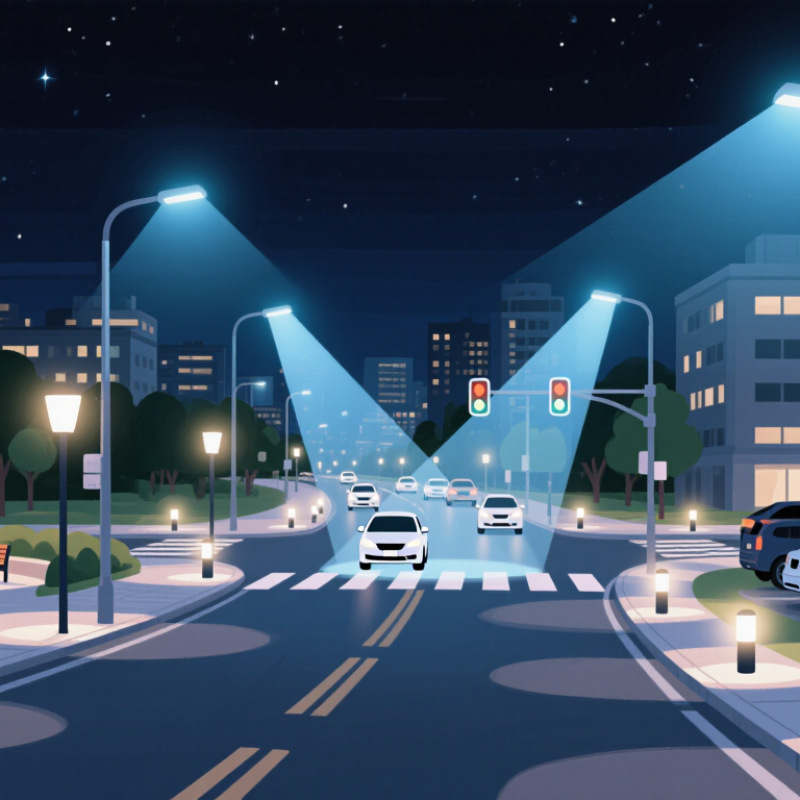
What Is a Street Outdoor Light and Which Type Is Best?

What Defines a Street Outdoor Light? ANSI/IES RP-8-22 Roadway Scope

A street outdoor light is not defined by its pole alone. Under ANSI/IES RP-8-22, roadway lighting is considered as part of a designed environment that supports visibility for drivers, pedestrians, and other road users. The practice addresses roadway and parking-facility lighting, with guidance shaped by conditions such as road layout, traffic, and surrounding activity. Context matters.

That means a suitable street light must do more than make the pavement look bright. Its light distribution, mounting height, spacing, and output affect how evenly people can see the road, crossings, and nearby objects. A bright patch beneath a pole can still leave dark gaps between fixtures. Glare can also make details harder to distinguish, especially on a wet street. Small design choices matter.

RP-8-22 provides professional recommendations, not a single fixture specification for every street. Designers assess the location and select lighting to meet its visual needs while considering energy use and maintenance. A quiet residential road and a busy intersection do not call for identical layouts. I would be cautious about choosing by lumen output alone; it is easy to overlook uniformity and pedestrian visibility. The standard helps structure that judgment, though real sites can be imperfect and may need review after installation.

How Street Luminaires Shape Visibility: Lux, Uniformity, and Glare

A street outdoor light is more than a bright point above the road. Its luminaire distributes light across lanes, sidewalks, and crossings, shaping what drivers and pedestrians can actually see. Lux measures light falling on a surface, but one average can hide dark patches. EN 13201-2:2015 sets pedestrian-area lighting classes from 15 lux for P1 to 2 lux for P6, with a minimum-to-average uniformity ratio of 0.4. The right class depends on use and surroundings, not a single “brighter is safer” rule. More is not always better.

Uniformity helps people notice a person stepping from between parked cars, instead of moving between pools of light and shadow. A drawing can look balanced; a wet road may not. Glare matters too: the CIE 115:2010 road-lighting report assesses disability glare using threshold increment, with criteria tied to lighting classes. Poorly controlled glare can make a bright luminaire uncomfortable while leaving the pavement harder to read. That matters at crossings. One caveat: lux alone is an incomplete promise. Good design considers placement, optics, mounting height, and the view from a driver’s eye, then checks the installation on site. A neat calculation still needs a real-world look.

What Is a Street Outdoor Light and Which Type Is Best?

How street luminaires shape visibility through illuminance, uniformity, and glare control.

This illustrative layout compares illuminance across a roadway. Uniformity is commonly assessed as minimum illuminance divided by average illuminance (Emin/Eavg); a higher value indicates fewer dark areas. A well-selected full-cutoff LED optic can provide even light while limiting high-angle light, but the best choice depends on the road, pole layout, mounting height, and verified glare performance. Values shown are examples, not product specifications or universal design targets.

Which Types Are Used? LED, HPS, Solar, and Networked Street Lights

A street outdoor light is a fixture designed to illuminate roads, sidewalks, parking areas, and other public spaces. The best type depends on road use, local weather, existing electrical service, and maintenance access. LED street lights are widely chosen because they use energy efficiently and provide clear, directed illumination. Their optics can help limit glare when properly selected. HPS lights produce a warm, amber tone and may still suit sites with existing HPS equipment, though their color rendering is limited. Light quality matters.

Tips: Check the required brightness, pole height, and beam pattern before comparing prices. For solar units, ask how long the battery supports the light during cloudy periods. A bright fixture is not automatically a safer one.

Solar street lights combine a panel, battery, and fixture, so they can work where wiring is difficult. Their performance depends on sunlight, battery capacity, and seasonal conditions; shaded poles can be a problem.

Networked street lights add remote controls and monitoring, rather than a different light source. Operators may adjust dimming schedules or receive fault alerts, but the system needs reliable connectivity and careful setup.

In practice, LED fixtures are often a sensible starting point, while solar or networked features should match the site’s real needs. I would still check the actual nighttime coverage before settling on a design.

Why LEDs Often Lead: Compare Efficiency, Controls, and Maintenance

A street outdoor light must do more than make a road look bright. It should put light on the pavement, limit glare into nearby windows, and remain dependable through rain and cold nights. LEDs often lead because they use less electricity and can be dimmed or scheduled. A U.S. Department of Energy roadway-lighting assessment reported energy savings of roughly 50% to 70% at evaluated LED installations compared with conventional lighting. Actual results depend on the old equipment, fixture design, and operating schedule.

Controls can trim use further. A dimming system can lower output late at night when traffic thins, then restore it when activity rises. That sounds simple. It still needs sensible settings and commissioning; a badly configured schedule may leave a crossing too dim or a lamp brighter than needed. Photocells can switch lights with changing daylight, while networked controls help crews identify outages without driving every route.

Maintenance is another advantage, but not a promise of zero repairs. LEDs generally need fewer lamp replacements than older high-pressure-sodium systems, reducing bucket-truck visits and disruption. Drivers, seals, and wiring can still fail, especially in harsh weather. The DOE’s 2017 report, Street Lighting and Energy Efficiency, notes that performance depends on selecting and installing suitable equipment. In practice, compare measured road-level illumination, glare, control compatibility, and replacement-part access—not wattage alone. One overlooked detail: a brighter-looking street is not always a safer or better-lit one.

What Is a Street Outdoor Light and Which Type Is Best? — Why LEDs Often Lead: Compare Efficiency, Controls, and Maintenance
Light type Typical system efficacy Typical rated life Controls and dimming Maintenance considerations Common strengths and trade-offs
LED About 100–180 lumens per watt for many outdoor luminaires; product performance varies. Often rated for 50,000–100,000 hours to a defined lumen-maintenance threshold. Usually well suited to dimming, photocells, occupancy-based controls, and networked systems when compatible components are specified. No routine lamp replacement; drivers, seals, optics, and surge protection still require inspection and may eventually need service. High efficacy, directional light, and flexible controls make LEDs a common choice for new installations. Upfront cost and component quality should be considered.
High-pressure sodium (HPS) About 80–140 lumens per watt, depending on lamp wattage and system losses. Often around 20,000–30,000 hours, with output and reliability changing over time. Basic photocell control is common. Dimming is possible with suitable equipment but is generally less flexible than with LED systems. Historically efficient and widely used for road lighting, but its yellow-orange appearance and limited color rendering may not suit every setting.
Metal halide About 70–120 lumens per watt for many lamp-and-ballast systems. Often around 10,000–20,000 hours; actual service life depends on lamp type and operating conditions. Photocell switching is common. Frequent switching and dimming may require specialized equipment. Lamps and ballasts require maintenance; light output and color can shift as lamps age. Can provide relatively good color quality, but generally uses more energy and requires more relamping than comparable modern LED installations.
Low-pressure sodium About 100–150 lumens per watt for many systems. Often around 15,000–20,000 hours, depending on lamp and operating conditions. Typically uses simple on/off control; dimming options are limited. Lamp replacement is required, and the specialized lamp format can make sourcing less convenient in some locations. Can be highly efficient, but its nearly monochromatic yellow light renders most colors poorly. It is now less common in many applications.
Induction About 60–90 lumens per watt for many systems. Often rated around 60,000–100,000 hours, though system components can have different service lives. Basic switching is common; dimming depends on the equipment and is not as widely available as for LED. Relamping may be infrequent, but generators and other system components can require service. Long lamp life is a potential advantage, but efficacy and product availability may be less favorable than current LED options.
How to compare: Efficacy is expressed in lumens per watt; higher values mean more light output per unit of electrical input. Figures are broad typical ranges, not guarantees. Compare complete luminaire performance, roadway light distribution, glare, color requirements, controls, climate, and warranty—not just the lamp rating. Rated life is not the same as guaranteed maintenance-free operation.

How to Specify Weather Protection: IEC 60529 IP66 Is Dust-Tight and Water-Jet Resistant

What Is a Street Outdoor Light and Which Type Is Best?

A street outdoor light must handle rain, dust, and regular cleaning. For exposed locations, an IP66 rating under IEC 60529 is a useful specification. The first “6” means the enclosure is dust-tight. The second “6” indicates protection against powerful water jets from different directions. Dust gets everywhere. Still, IP66 does not mean the light can be submerged.

Tips: Check the full installed assembly, not just the lamp housing. Cable glands, gaskets, and closed access covers matter. A loose connector can undermine a well-rated enclosure.

Match the rating to the site. Roadsides near heavy spray or dusty work areas may benefit from IP66 protection. But the rating does not measure corrosion resistance, UV durability, or impact strength. Those need separate checks. Inspect seals and fittings during maintenance, especially after opening the enclosure. In practice, installation details are easy to overlook, and ratings cannot compensate for damaged parts. Choose a fixture with clear documentation for its intended mounting position and service conditions.