What Are the Top Types of Shipbuilding Panel Lines?
Shipyards do not build every vessel panel the same way. A Shipbuilding Panel Line may process flat plates, fit stiffeners, weld subassemblies, or handle curved sections. The right setup depends on vessel design, production volume, available floor space, and how consistently the yard can supply parts. Details matter: a plate entering one end should leave with accurate seams, stable geometry, and little rework. Small errors travel.
UNCTAD’s Review of Maritime Transport 2024 reported that the global commercial fleet grew 3.4% in deadweight terms during 2023. That figure describes fleet capacity, not demand for panel-line equipment. Still, it shows the scale of an industry under pressure to renew and expand production. For yards comparing options, useful categories include conventional flat-panel lines, automated panel lines, stiffener-installation lines, and systems for curved panels. Each trades flexibility against throughput, labor needs, and investment. More automation is not automatically better. A highly automated line can struggle when product mix changes or upstream parts arrive late. This is an important limitation, and it is easy to overlook in sales claims.
This guide compares the main line types by their processes, strengths, and practical constraints. It also considers where mechanization can improve repeatability—and where skilled operators remain essential. Shop-floor conditions vary. A line that performs well in a large new facility may not fit an older yard with tight material flow. The best choice starts with actual vessel programs, not a machine brochure.
Flat Panel Lines for Producing Large, Planar Ship Sections
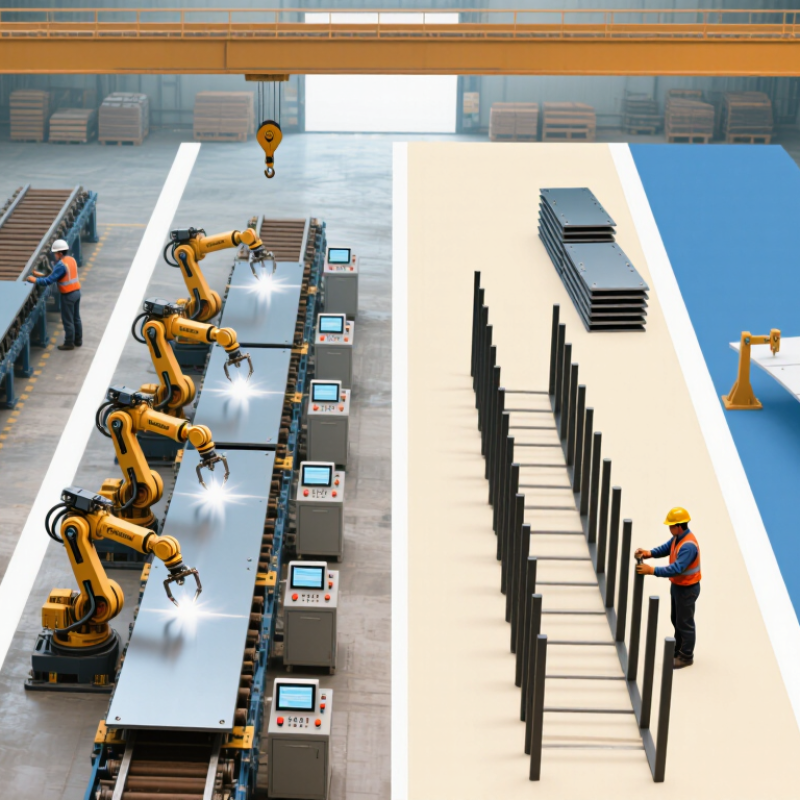
Flat panel lines assemble broad, flat ship sections before they are joined into larger hull blocks. Typical stations cut and bevel plate, position stiffeners, tack components, weld seams, and inspect finished panels. Overhead cranes move heavy plates between work areas, while fixtures help maintain alignment. The line’s value is repeatable flow, not speed alone. A misaligned stiffener can create rework downstream. Small details matter.
UNCTAD’s Review of Maritime Transport 2024 reports that the world fleet grew by 3.4% in 2023.
That figure describes fleet capacity, not shipyard production or panel-line performance; it does, however, show why yards need dependable fabrication workflows. A well-planned line can reduce manual handling and keep work moving between stations, provided panel dimensions, weld sequences, and crane access are coordinated. Automation can support consistency, but it cannot fix poor fit-up or unclear work instructions.
I have seen planning assumptions look convincing on paper, then falter when panel variation reaches the line. Allow space for inspection and correction.
Metrics such as rework hours, throughput, and first-pass weld acceptance reveal more than output totals alone. Reference: UNCTAD, Review of Maritime Transport 2024.
Curved Panel Lines for Forming Hull and Superstructure Sections
Curved panel lines form the gently rounded plates used in ship hulls and superstructures. Their equipment may include plate feeders, presses, bending rolls, and positioning systems. The exact setup depends on plate thickness, curvature, and production volume. A broad hull section may need gradual rolling, while a tighter transition can require staged pressing. Not every curve behaves.
Operators check the plate against design templates or digital measurements during forming. Springback matters: metal can relax slightly after pressure is released, leaving the curve wider than intended. Trial bends help crews adjust the process before shaping a full-size panel. Small errors can add up. Heat may also be used in some forming methods, but uneven heating can distort a plate and complicate later assembly.
After forming, the panel is checked for curvature, edge alignment, and fit with adjoining sections. Crews may correct local deviations before stiffeners or other components are attached. The work is not always perfectly repeatable; material variation and handling can change the result. Careful measurement at several points gives a more useful picture than checking only the panel’s ends.
Stiffened Panel Lines for Reinforcing Structural Panels
A stiffened panel line turns flat steel plate into a stronger, easier-to-assemble hull section. The usual sequence includes plate preparation, stiffener positioning, tack welding, final welding, and dimensional checks. Longitudinal bars resist bending along the hull; transverse members help control panel shape. On the shop floor, a small gap beneath a stiffener can become a visible distortion after welding. Fit matters. So does sequence.
UNCTAD’s Review of Maritime Transport 2024 reports that China, the Republic of Korea, and Japan produced about 95% of global ship deliveries by gross tonnage in 2023. That concentration highlights the scale and repeatability expected in modern yards, though it does not measure panel-line productivity. A well-planned line can standardize spacing, handling, and weld access across repeated panels. Operators still need to check plate flatness, stiffener alignment, and heat effects. Automation helps, but it cannot correct a poor fit-up.
Useful line controls include clear datum marks, consistent clamping, and inspection after welding and straightening. A practical detail: check the panel’s diagonals before release, not only its edge dimensions. Small errors travel. Yet the ideal process varies with plate thickness, panel geometry, and vessel design. Production targets can also tempt teams to overlook rework time. That is worth questioning; speed without dimensional control may simply move the delay downstream.
What Are the Top Types of Shipbuilding Panel Lines?
Stiffened Panel Lines: Example Stiffener Section Areas
This comparison uses example dimensions and idealized geometry: flat bar 100 × 8 mm, angle 75 × 50 × 6 mm, tee with a 100 × 8 mm flange and 80 × 6 mm web, and channel with two 50 × 6 mm flanges and a 100 × 6 mm web. The plotted areas are calculated from those dimensions; they are illustrative, not standard sizes. Section area alone does not determine structural strength, which also depends on material, panel layout, loading, and buckling behavior.
Subassembly Panel Lines for Joining Smaller Structural Components
Subassembly panel lines join smaller structural components before they become larger ship sections. Typical work includes fitting stiffeners, brackets, clips, and smaller plates to a panel. Workers or automated equipment position each part against marked references, then tack and weld it in place. Fit matters here. A small gap can affect weld quality or pull a panel out of shape as heat builds.
A practical line groups tasks around the parts’ size and sequence. Fixtures hold plates steady, while conveyors or overhead handling equipment move assemblies between stations. Clear access for welding and inspection matters as much as cycle speed. Operators check alignment, weld appearance, and key dimensions at suitable points, rather than waiting until the panel is complete. Small errors travel. No line is perfectly balanced every shift; part variation, rework, and changing job mixes can interrupt flow. That is worth reviewing when setting station capacity. A useful subassembly line makes components easy to locate, secure, join, and inspect, while leaving enough room to correct a fit that is not quite right.
Flexible Panel Lines for Handling Multiple Panel Designs
A flexible shipbuilding panel line is designed to switch between panel sizes, stiffener layouts, and production batches without rebuilding the whole process. This matters when a yard handles both broad deck panels and smaller bulkhead sections. Adjustable fixtures, programmable welding heads, and movable conveyors let crews change layouts while keeping plates aligned. The details matter: a few millimeters of mismatch can create extra fitting work downstream.
UNCTAD’s Review of Maritime Transport 2024 reports that China, the Republic of Korea, and Japan together produced roughly 94% of global shipbuilding output in 2023.
Such concentration underscores the value of dependable production, but flexibility is not simply a faster machine. A line needs accurate setup data, trained operators, and clear changeover routines. Otherwise, frequent design changes can increase downtime instead of reducing it.
Small batches are especially demanding. A yard may need to pause and recalibrate when panel thickness or stiffener spacing changes. That is a real limitation, and it deserves attention during line planning.
A practical design balances automated welding with accessible stations for inspection and manual correction, so crews can catch distortion before panels move to assembly.